

This text is taken from the book
“The sumerian mith translated and commented.
with a glossary of terms”
View the book index and description
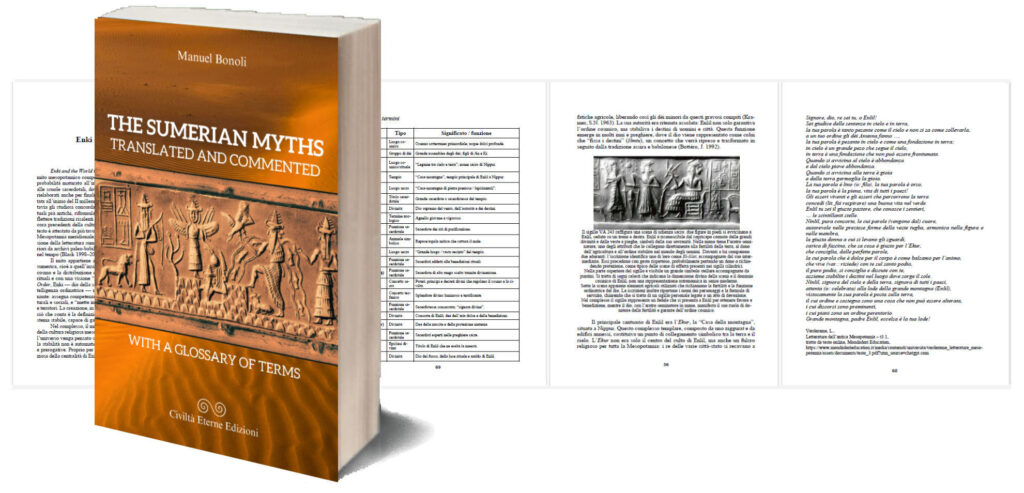

The following passage belongs to the oldest Sumerian lyrical tradition, specifically to the corpus of the Love Songs of Inanna and Dumuzi, a series of poetic compositions celebrating the ritual union between the goddess Inanna and the shepherd-god Dumuzi (Kramer 1961; Jacobsen 1976; Black et al. 2004). Although the text is clearly of Sumerian origin and most likely dates to the period of the Third Dynasty of Ur (ca. 2100–2000 BCE), its modern preservation depends largely upon Old Babylonian copies (ca. 1900–1700 BCE) discovered at sites such as Nippur, Ur, Isin, and Susa (Kramer 1961; Hallo 1997). Copied within the scribal schools, the poem was transmitted as part of the classical tradition of Sumerian literature, closely associated with fertility cults and the urban ceremonies of Unug/Uruk (Jacobsen 1976; Black et al. 2004).
The significance of the text lies in its symbolic representation of cosmic fertility: the erotic union between Inanna and Dumuzi is not merely a love dialogue, but a sacred act that renews life, ensures the abundance of the harvests, and guarantees the prosperity of the community (Jacobsen 1976; Cooper 1993). Agricultural and pastoral imagery — ploughing, milk, fields, sheepfolds — expresses the continuity between nature, divinity, and society, demonstrating how divine love functions as the source of the vital order sustaining the entire Mesopotamian world (Kramer 1961; Cooper 1993).

Translation
My vulva, the horn,
the Boat of Heaven,
is full of eagerness like the young moon.
My untilled land lies fallow.
As for me, Inanna,
who will plough my vulva?
Who will plough my high field?
Who will plough my wet ground?
As for me, the young woman,
who will plough my vulva?
Who will place the ox there?
Who will plough my vulva?
…
Make your milk sweet and thick, my bridegroom.
My shepherd, I will drink your fresh milk.
Wild bull, Dumuzi, make your milk sweet and thick.
I will drink your fresh milk.
Let the goat’s milk flow into my sheepfold.
Fill my holy churn with honey-cheese.
Lord Dumuzi, I will drink your fresh milk.
Wikipedia, Dumuzid,
online encyclopedic entry,
Wikimedia Foundation,
English translation Samuel Noah Kramer and Diane Wolkstein
Table of Terms
| Term | Description / Meaning | |
| Inanna (Inana) | Great Sumerian goddess of love, sexuality, fertility, and kingship; central figure of the erotic-ritual song. | |
| Dumuzi | Young shepherd-god, sacred spouse of Inanna; symbol of fertility, virile strength, and abundance. | |
| vulva | In the Sumerian erotic hymns, the term refers both to the female genitalia and to a symbol of fertility, sexuality, sacred union, and generative power. |
Textual Analysis
This hymn is among the most beautiful and intense works of Sumerian poetry (Kramer 1961; Black et al. 2004). It is a love song, though not in the modern sense of the term: it does not merely speak of desire between two individuals, but narrates the sacred union between the goddess Inanna and her beloved Dumuzi, the deified shepherd (Jacobsen 1976). It is a composition that unites sensuality and religion, body and cosmos, in which every erotic image simultaneously becomes a symbol of the fertility of the earth and the renewal of life (Wolkstein and Kramer 1983).
From the very beginning, the voice of Inanna is that of a woman burning with desire, yet her desire is cosmic and creative (Jacobsen 1976). She declares: “My vulva, the horn, the Boat of Heaven, is full of eagerness like the young moon.” These are words that may appear provocative today, yet within the Sumerian world they were sacred (Kramer 1961). The vulva is not merely the female sexual organ; it is the earth itself, the field awaiting the plough, waiting for the seed (Cooper 1993). The horn evokes the bull, the sacred animal of virility and generative strength; the “Boat of Heaven” is the womb that receives and carries life (Black and Green 1992). The “young moon,” meanwhile, symbolizes the cycle of time, growth, and rebirth (Jacobsen 1976). The entire language of the hymn is shaped by agricultural and cosmic symbolism: sexuality becomes a metaphor for universal fertility (Cooper 1993).
When Inanna asks, “Who will plough my vulva? Who will plough my wet ground?” she is not simply speaking of her body, but invoking the sacred moment in which masculine potency — seed, rain, life itself — will penetrate the earth in order to fertilize it (Wolkstein and Kramer 1983). It is the voice of nature calling for fecundation, not merely a woman calling to her lover (Jacobsen 1976). Inanna is the earth, while Dumuzi is the shepherd, the man who with his ox will plough the fields of the goddess: it is the poetic representation of a ritual act, of a divine marriage that guarantees the renewal of life (Kramer 1961).
Within Sumerian religion, this act possessed a concrete ritual significance: the king, embodying Dumuzi, symbolically united his body with that of the priestess of Inanna in order to ensure the fertility of the fields and the prosperity of the people (Jacobsen 1976; Cooper 1993). What appears here as an erotic love song was, within the temples, a hymn recited during the rite of the sacred marriage, in which human pleasure became the very force that set the cosmos in motion (Cooper 1993).
The second part of the text is gentler and more intimate (Wolkstein and Kramer 1983). Inanna addresses Dumuzi by calling him “my bridegroom,” “my shepherd,” “wild bull,” and says to him: “Make your milk sweet and thick, my bridegroom. I will drink your fresh milk.” Milk here symbolizes the flow of life, nourishment, and the force that passes from the masculine to the feminine (Black and Green 1992). At once it represents both seed and the gift of love, the substance that sustains the world (Jacobsen 1976). When Inanna declares, “let the goat’s milk flow into my sheepfold,” she is effectively saying: let life enter my womb, let the earth be filled with fruitfulness (Kramer 1961).
Even the cheese and honey that are mentioned belong to this language of abundance: they are the result of labor, transformation, and the wealth produced through union (Cooper 1993). Although explicit, the tone of the text is never vulgar (Wolkstein and Kramer 1983). It is intense, filled with vital joy. The eroticism of Inanna is not sensual in the modern sense; it is sacred, necessary for the continuation of the world (Jacobsen 1976). The goddess speaks simultaneously as woman and divinity, and her desire is itself the force of creation (Black et al. 2004). In her, passion becomes a cosmic principle: the body is the instrument through which the cosmos renews itself (Cooper 1993).
Dumuzi, with his virile gentleness, represents the complementary half of this energy (Kramer 1961). He is called “wild bull” not because of brutality, but because of his natural strength (Black and Green 1992). He is the seed; she is the field. He is the rain; she is the earth that receives it (Jacobsen 1976).
Everything within this hymn moves through a balance of opposites: desire and tenderness, strength and receptivity, earth and heaven (Wolkstein and Kramer 1983). The poem transforms the sexual union into a cosmic rite: through the union of the two divine lovers, nature itself is regenerated, the fields become green once more, the animals multiply, and the people prosper (Cooper 1993). It reflects the ancient belief that human life, sexuality, and the fertility of the earth are one and the same reality (Jacobsen 1976).
In the end, what remains is a sense of complete harmony (Black et al. 2004). The voice of Inanna is not merely that of a woman in love, but that of the world itself singing its hunger for life (Wolkstein and Kramer 1983). It is a hymn in which eros is not guilt, but prayer; not disturbance, but promise (Jacobsen 1976). The goddess and the shepherd seek one another, unite, and through their union life is reborn: milk flows, honey forms, the moon waxes, and plants begin to sprout once again (Kramer 1961).
Bibliography
- Black, J. Cunningham, G. Ebeling, J. Flückiger-Hawker, E. Robson, E. Taylor, J. Zólyomi, G., The Literature of Ancient Sumer, 2004
- Black, J. Green, A., Gods, Demons and Symbols of Ancient Mesopotamia An Illustrated Dictionary, 1992
- Cooper, J. S., Sacred Marriage and Popular Cult in Early Mesopotamia, 1993
- Hallo, W. W., Origins The Ancient Near Eastern Background of Some Modern Western Institutions, 1997
- Jacobsen, T., The Treasures of Darkness A History of Mesopotamian Religion, 1976
- Kramer, S. N., Sumerian Mythology A Study of Spiritual and Literary Achievement in the Third Millennium B C, 1961
- Wolkstein, D. Kramer, S. N., Inanna Queen of Heaven and Earth Her Stories and Hymns from Sumer, 1983

Comments (0)