

This text is taken from the book
“The sumerian mith translated and commented.
with a glossary of terms”
View the book index and description

The myth “Inanna and the Huluppu Tree” belongs to the oldest core of Sumerian religious literature and constitutes one of the earliest mythological testimonies dedicated to the goddess of Uruk. Composed during the third millennium BCE and transmitted in the Sumerian language, the narrative emerges within a cultural context in which cosmology, kingship, and natural symbolism were profoundly interconnected. Through a narration rich in poetic imagery and symbolic figures, the myth addresses central themes of Mesopotamian thought, including the origin of cosmic order, the relationship between chaos and civilization, the role of divine sovereignty, and the collaboration between divine and heroic power. The ḫuluppu tree thus becomes the narrative fulcrum around which a mythic reflection develops concerning the transformation of nature into culture and the emergence of kingship as an instrument of balance and continuity within the world.
The term ḫuluppu does not possess a certain or unequivocal meaning that can be translated through a modern equivalent. It is an archaic Sumerian word referring to a sacred tree, although it cannot be identified with precision from a botanical perspective. The word has not been securely translated as the name of a specific plant — whether, for example, an oak, a willow, or another species of tree remains unknown — and it is therefore understood primarily as a mythological designation rather than as an exact natural classification.
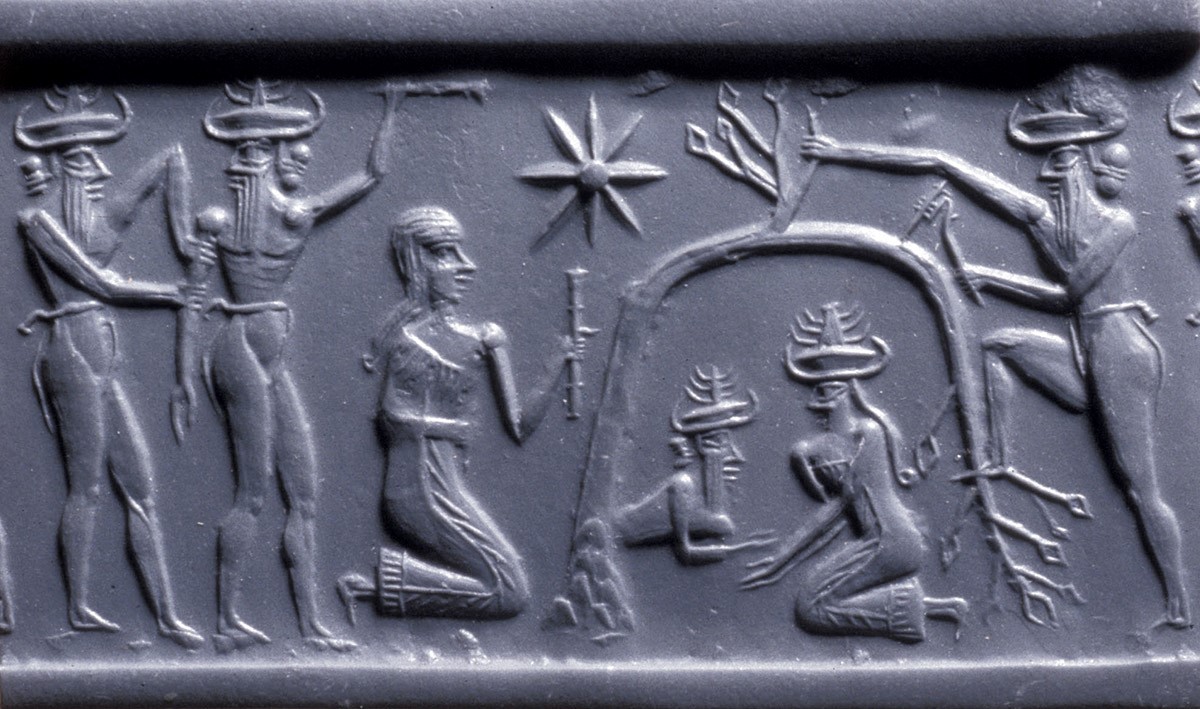
The tree is not an inert element; rather, it is an inhabited space and a threshold between worlds. This explains why one of the horned-crown figures appears to emerge directly from the trunk: the deity is not simply standing behind the tree but manifests through it. The divine presence is immanent within the tree, which functions as a vehicle or embodiment of the sacred, making visible what is normally invisible.
Within the space enclosed by the curved tree appears a female deity, perhaps the goddess Inanna, while outside stand divine-ranking figures identifiable by their heroic nudity and horned crowns. Above them, an eight-pointed star signifies the cosmic dimension of the scene and connects the event to the universal order.
Taken as a whole, the seal does not appear to narrate a specific episode but rather evokes a sacred act of manifestation and the re-establishment of order, in which the sacred tree serves as an axis linking heaven and earth. Images of this type are often associated with myths of the sacred tree, such as the story of the Huluppu Tree, while remaining open to multiple levels of interpretation.
Translation
In the first days, in the very first days,
In the first nights, in the very first nights,
In the first years, in the very first years,
In the first days, when all things necessary had been brought into being,
In the first days, when all things necessary had been properly nourished,
When bread was baked in the earthen temples,
And bread was tasted in the houses of the land,
When heaven had been separated from earth,
And earth had been divided from heaven,
And the name of mankind had been established;
When An, the God of Heaven, had taken possession of the heavens,
And Enlil, the god of Air, had taken possession of the earth,
When to Ereshkigal, Queen of the Great Below, the underworld had been given as dominion,
He set sail; the Father set sail,
Enki, the God of Wisdom, set sail toward the underworld.
Small grains of wind were hurled against him;
Great pellets of hail were hurled against him;
Like swift sea turtles,
They struck the keel of Enki’s vessel.
Like wolves, the waters of the sea devoured the prow of his vessel;
Like lions, the waters of the sea hurled themselves against the stern of his vessel.
At that time a tree, a single tree, a ḫuluppu tree,
Was planted upon the banks of the Euphrates.
The tree was nourished by the waters of the Euphrates.
The raging South Wind arose, tore out its roots,
And scattered its branches,
Until the waters of the Euphrates carried it away.
A woman, whose steps were guided by reverence for the word of An, God of Heaven,
Whose steps were guided by reverence for the word of Enlil, God of Air,
Drew the tree from the river and spoke:
“I shall carry this tree to Uruk.
I shall plant this tree within my sacred garden.”
Inanna cared for the tree with her own hands.
She pressed the earth around the tree with her own feet.
Inanna asked herself:
“How long must pass before I shall have a shining throne upon which to sit?
How long must pass before I shall have a shining bed upon which to lie?”
The years passed; five years, then ten years.
The tree grew strong,
Yet its bark did not split open.
Then a serpent immune to incantations
Made its nest among the roots of the ḫuluppu tree.
The Anzu bird placed its young within the branches of the tree.
And the dark maiden, Lilith, made her dwelling within the trunk.
The young woman who loved laughter wept.
Oh, how Inanna wept!
(And yet they would not depart from her tree.)
When the birds began to sing, at the coming of dawn,
Utu, the Sun God, arose from the royal bedchamber.
Inanna addressed her brother Utu and said:
*“Utu, in the days when the destinies were decreed,
When the Earth overflowed with abundance,
When the God of Heaven took possession of the heavens and the God of Air the earth,
When to Ereshkigal the Great Below was given as dominion,
The God of Wisdom, Father Enki, set sail toward the underworld,
And the underworld rose up against him and assailed him…
At that time a tree, a single tree, a* ḫuluppu *tree,
Was planted upon the banks of the Euphrates.
The South Wind tore out its roots and scattered its branches,
Until the waters of the Euphrates carried it away.
I drew the tree from the river; I carried it into my sacred garden.
I cared for the tree while awaiting my shining throne and my shining bed.
Then a serpent immune to incantations
Made its nest among the roots of the tree,
The Anzu bird placed its young within the branches of the tree,
And the dark maiden, Lilith, made her dwelling within the trunk.
I wept.
Oh, how I wept!
(And yet they would not depart from my tree.)”*
Utu, the valiant warrior, Utu,
Would not help his sister Inanna.
When the birds began to sing, at the coming of the second dawn,
Inanna addressed her brother Gilgamesh and said:
*“O Gilgamesh, in the days when the destinies were decreed,
When Sumer overflowed with abundance,
When the God of Heaven had taken possession of the heavens and the God of Air the earth,
When to Ereshkigal the Great Below was given as dominion,
The God of Wisdom, Father Enki, set sail toward the underworld,
And the underworld rose up against him and assailed him.
At that time a tree, a single tree, a* ḫuluppu tree,
Was planted upon the banks of the Euphrates.
The South Wind tore out its roots and scattered its branches,
Until the waters of the Euphrates carried it away.
I drew the tree from the river; I carried it into my sacred garden.
I cared for the tree while awaiting my shining throne and my shining bed.”
Then a serpent immune to incantations
Made its nest among the roots of the tree,
The Anzu bird placed its young within the branches of the tree,
And the dark maiden, Lilith, made her dwelling within the trunk.
I wept.
Oh, how I wept!
(And yet they would not depart from my tree.)”
Gilgamesh, the valiant warrior, Gilgamesh,
The hero of Uruk, did not abandon Inanna.
Gilgamesh girded his chest with armor weighing fifty minas.
To him, fifty minas weighed no more than fifty feathers.
He lifted the bronze axe, the axe of the road,
Weighing seven talents and seven minas, and placed it upon his shoulder.
He entered the sacred garden of Inanna.
Gilgamesh struck down the serpent immune to incantations.
The Anzu bird flew with its young toward the mountains;
And Lilith destroyed her dwelling and fled to wild and uninhabited places.
Gilgamesh then freed the roots of the ḫuluppu tree;
And the sons of the city who accompanied him cut away its branches.
From the trunk of the tree he fashioned a throne for his divine sister.
From the trunk of the tree Gilgamesh fashioned a bed for Inanna.
From the roots of the tree she fashioned a pukku for her brother.
From the crown of the tree Inanna fashioned a mikku for Gilgamesh, the hero of Uruk.
Excerpted from La Grande Dea. Il viaggio di Inanna regina dei mondi,
di Sylvia Brinton Perera, Red Edizioni, Como, 1987
English translation by Manuel Bonoli
Table of Terms
| Term | Meaning | |
| An | God of the Sky, head of the pantheon and guarantor of cosmic order. | |
| Anzu | Monstrous bird endowed with terrifying powers, associated with storms and the theft of divine powers. | |
| Enki | God of wisdom and subterranean waters (abzu); lord of magic, ingenuity, and regeneration. | |
| Enlil | God of air and storms; lord of kingship, the earth, and the decrees of destiny. | |
| Ereshkigal | Queen of the “Great Below,” sovereign of the underworld and the realm of the dead. | |
| Euphrates | Great river of Mesopotamia, symbol of fertility, life, and communication. | |
| Gilgamesh | Hero-king of Uruk, protagonist of the Sumerian and Akkadian epic that bears his name. | |
| Huluppu (huluppu-tree) | Sacred tree growing on the banks of the Euphrates; from its wood are fashioned the throne, bed, pukku, and mikku. | |
| Inanna | Goddess of love, war, fertility, and sovereignty; lady of Uruk. | |
| Lilith | Nocturnal female figure inhabiting the huluppu tree; in later traditions associated with a malevolent demon. | |
| Mikku | Ritual staff or instrument, often interpreted as a scepter or mace, made from the top of the huluppu tree and given to Gilgamesh. | |
| Pukku | Ritual object or sound-producing instrument, sometimes interpreted as a drum or sacred game, fashioned from the roots of the huluppu tree. | |
| Sumer | Region of southern Mesopotamia and cradle of Sumerian civilization. | |
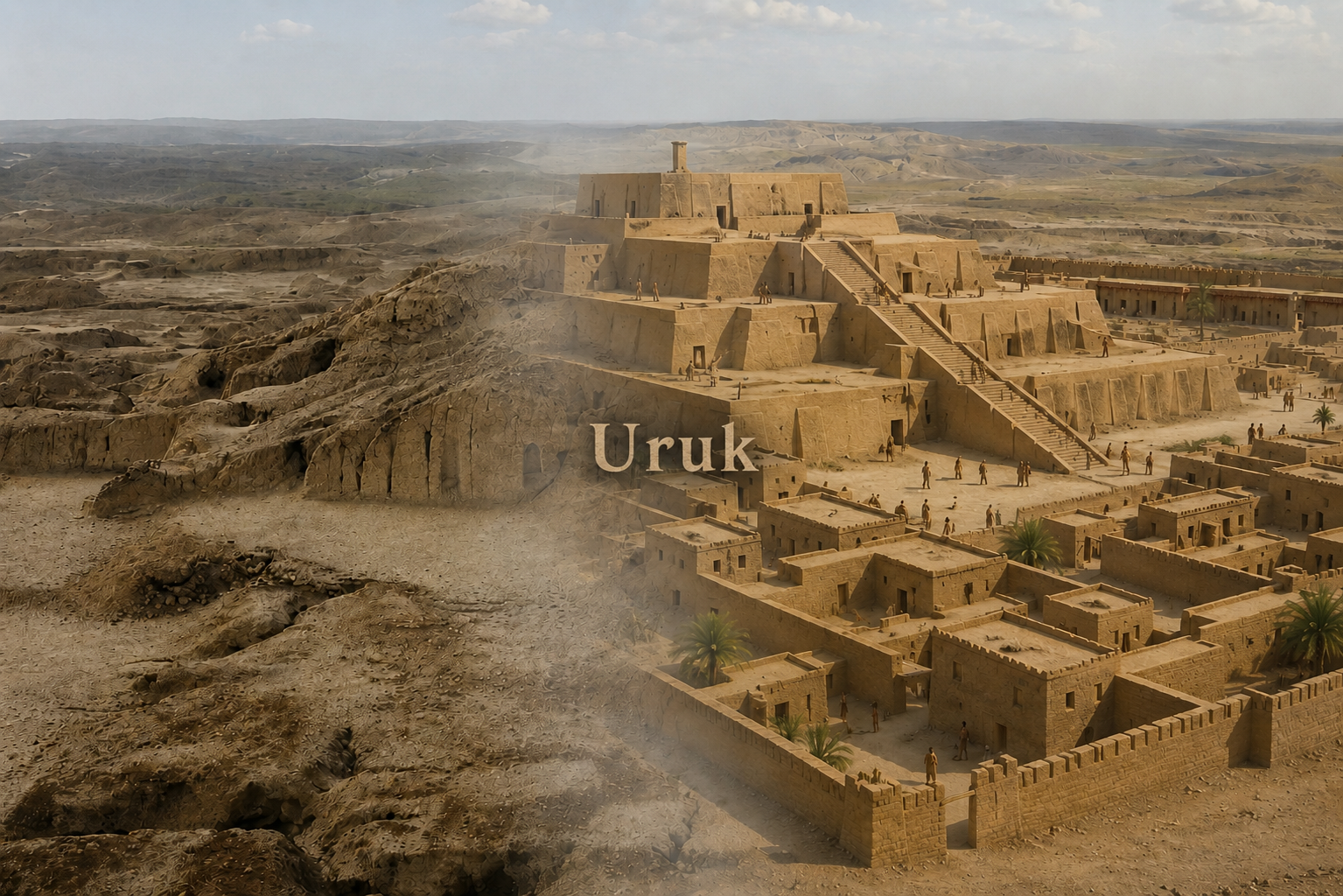
| Uruk | Great Sumerian city and principal cult center of Inanna; homeland of Gilgamesh. | |
| Utu | God of the Sun and justice, brother of Inanna, invoked against the serpent, Anzu, and Lilith. |
Textual Analysis
The myth of Inanna and the ḫuluppu tree is one of the oldest and most complex narratives of the Sumerian tradition (Kramer 1963; Hallo, Van Dijk 1968). The text, preserved on a tablet originating from Uruk and datable to the third millennium BCE, is written in the Sumerian language and belongs to the earliest phase of Mesopotamian mythological poetry (Jacobsen 1976). It constitutes one of the first narrative attestations dedicated to Inanna, the goddess who in the Akkadian period would later be identified with Ishtar, and represents a crucial point of intersection between cosmology, kingship, and sexual symbolism (Bottéro 2001).
The narrative opens within an absolute mythical time, evoked through the solemn repetition “In the first days, in the very first days… In the first years, in the very first years.” This anaphora possesses not merely poetic value, but also creates a suspension of time that situates the story at the moment when the cosmos itself is still in the process of formation (Jacobsen 1976). When the text states that “all things necessary had been brought into being” and “properly nourished,” creation is not described as an instantaneous act, but rather as a gradual process of stabilization and care, consistent with the Mesopotamian conception of an order that must continually be maintained through time (Bottéro 1992). In this context, the phrase “the name of mankind had been established” signifies humanity’s entrance into the cosmic order: to name something is to render it existent, recognized, and integrated within a network of relationships (Civil 1987).
The primordial separation between heaven and earth (“when heaven had been separated from earth”) constitutes one of the fundamental cosmogonic gestures of Mesopotamian thought (Jacobsen 1976). Only through this distinction does a habitable space come into being. This act is followed by the distribution of the divine domains: “An had taken possession of the heavens… Enlil the earth… to Ereshkigal was given the underworld.” The cosmos thus appears as an ordered system structured according to distinct spheres of competence, in which equilibrium derives from delimitation rather than fusion, following a logic characteristic of Sumerian theology (Bottéro 2001).
Into this newly established order enters the journey of Enki: “Enki, God of Wisdom, set sail toward the underworld.” Navigation here becomes a metaphor for knowledge that crosses forbidden and dangerous boundaries (Jacobsen 1976). The violent images that follow (“like wolves… like lions”) personify the Netherworld as a reactive and hostile force: wisdom is not neutral, but entails risk, exposure, and confrontation with primordial chaos (Black, Green 1992).
Immediately afterward appears the ḫuluppu tree, “a tree, a single tree,” planted upon the banks of the Euphrates. The insistence upon its uniqueness underscores its symbolic significance (Kramer 1963). The tree, often identified as a willow or poplar, represents life, fertility, and the cosmic axis linking heaven, earth, and the underworld (Jacobsen 1976). The fact that it is uprooted by the South Wind and carried away by the waters reflects a condition of sacredness that remains unstable, exposed to the chaotic forces of nature, particularly the ambivalent power of the Mesopotamian rivers, sources both of life and destruction (Bottéro 1992).
It is Inanna who intervenes as a civilizing figure. When she declares, “I drew the tree from the river… I shall plant it within my sacred garden,” the goddess performs a foundational act: she removes a wild element from the chaos of the river and places it within a ritual space, the sacred garden of Uruk, a place of mediation between nature and culture (Hallo, Van Dijk 1968). The concrete gestures (“she cared for the tree with her own hands”) demonstrate that sovereignty, even divine sovereignty, requires labor, time, and patience, rather than immediate power alone (Jacobsen 1976). The desire for the “shining throne” and the “shining bed” does not allude merely to comfort, but to the two fundamental poles of kingship: political authority and sexual fecundity, intimately connected within the Mesopotamian conception of sovereignty (Jacobsen 1976; Bottéro 2001).
The dramatic core of the myth emerges when the tree becomes the dwelling place of three troubling presences: “the serpent immune to incantations,” “the Anzu bird,” and “the dark maiden, Lilith” (Kramer 1963). These figures occupy respectively the roots, the trunk, and the branches, completely paralyzing the symbolic function of the tree. The serpent, a chthonic creature resistant to ritual control, embodies an untamable primordial force; Anzu represents cosmic chaos and rebellion against divine order; Lilith (Lilitu) embodies a dangerous and antisocial sexuality, the dark and unintegrated aspect of femininity (Black, Green 1992). Thus infested, the tree can no longer become an instrument of kingship nor a foundation of order.
The weeping of Inanna (“Oh, how I wept!”) is not merely an emotional expression, but a ritual act signaling a cosmic imbalance (Jacobsen 1976). Utu’s refusal to intervene (“he would not help his sister”) is highly significant: the Sun God and deity of justice represents established order, yet proves powerless before a chaos that demands not judgment, but violent and transformative action (Bottéro 1992).
It is at this moment that Gilgamesh enters the scene. The hyperbolic description of his weapons (“fifty minas weighed for him no more than fifty feathers”) employs epic amplification to emphasize his superhuman nature, characteristic of Mesopotamian heroic style (George 2003). Gilgamesh does not create order out of nothing; rather, he restores it: he slays the serpent and drives away Anzu and Lilith, thereby reestablishing the possibility of transforming the tree (Kramer 1963). It is significant that the chaotic forces are not annihilated but relocated (“she fled to wild and uninhabited places”): the myth does not eliminate chaos, but confines it, acknowledging its inevitable presence at the margins of the ordered world (Jacobsen 1976).
Only after this purification can the tree be transformed. From its trunk are fashioned the throne and bed of Inanna, symbols of royal authority and erotic union, perhaps alluding to the sacred marriage (hieros gamos) that guaranteed fertility and prosperity to the city and the kingdom (Jacobsen 1976). From the roots and crown of the tree are fashioned the pukku and the mikku for Gilgamesh, ambiguous ritual objects associated with destiny, sacred play, and the world of the dead, which will later reappear in the episode of Gilgamesh, Enkidu, and the Netherworld (George 2003). What had once been a threat thus becomes the very foundation of civilization.
Taken as a whole, the myth presents a profoundly Sumerian vision of existence: the world is born through separation, yet it can endure only through care; kingship is not immediate, but must mature; order does not destroy chaos, but transforms it (Bottéro 2001). The ḫuluppu tree therefore becomes a metaphor for the raw material of existence which, through the collaboration between goddess and hero, is converted into culture, legitimate power, and cosmic continuity. It is a narrative of both divine and human initiation, in which Inanna passes from youth to full sovereignty, while humanity, through Gilgamesh, takes a decisive step toward civilization (Jacobsen 1976; George 2003).
Bibliography
- Black, J. – Green, A., Gods, Demons and Symbols of Ancient Mesopotamia, 1992
- Bottéro, J., Religion in Ancient Mesopotamia, 1992
- Bottéro, J., Mesopotamia: Writing, Reasoning, and the Gods, 2001
- Civil, M., The Early Dynastic Practical Vocabulary, 1987
- George, A. R., The Babylonian Gilgamesh Epic, 2003
- Hallo, W. W. – Van Dijk, J. J. A., The Exaltation of Inanna, 1968
- Jacobsen, T., The Treasures of Darkness: A History of Mesopotamian Religion, 1976
- Kramer, S. N., Sumerian Mythology, 1963

Comments (0)