

This text is taken from the book
“The sumerian mith translated and commented.
with a glossary of terms”
View the book index and description
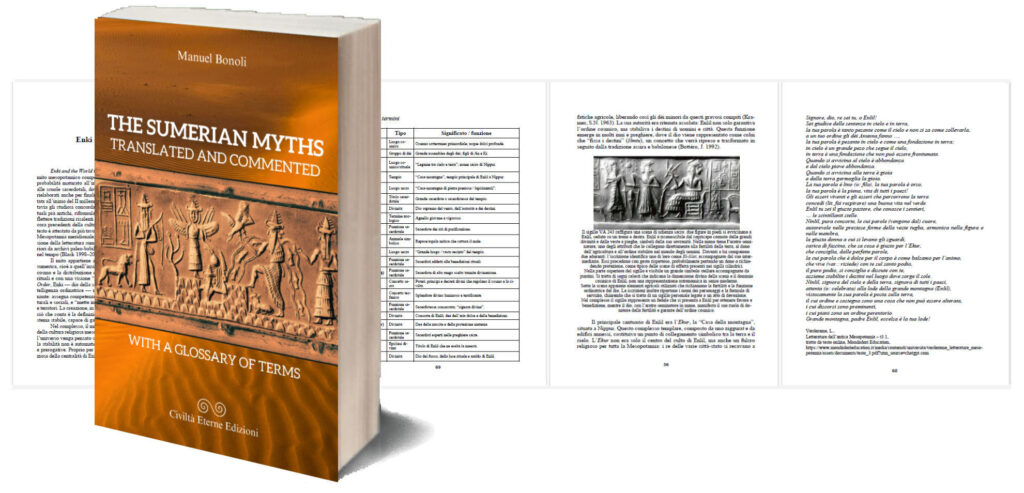

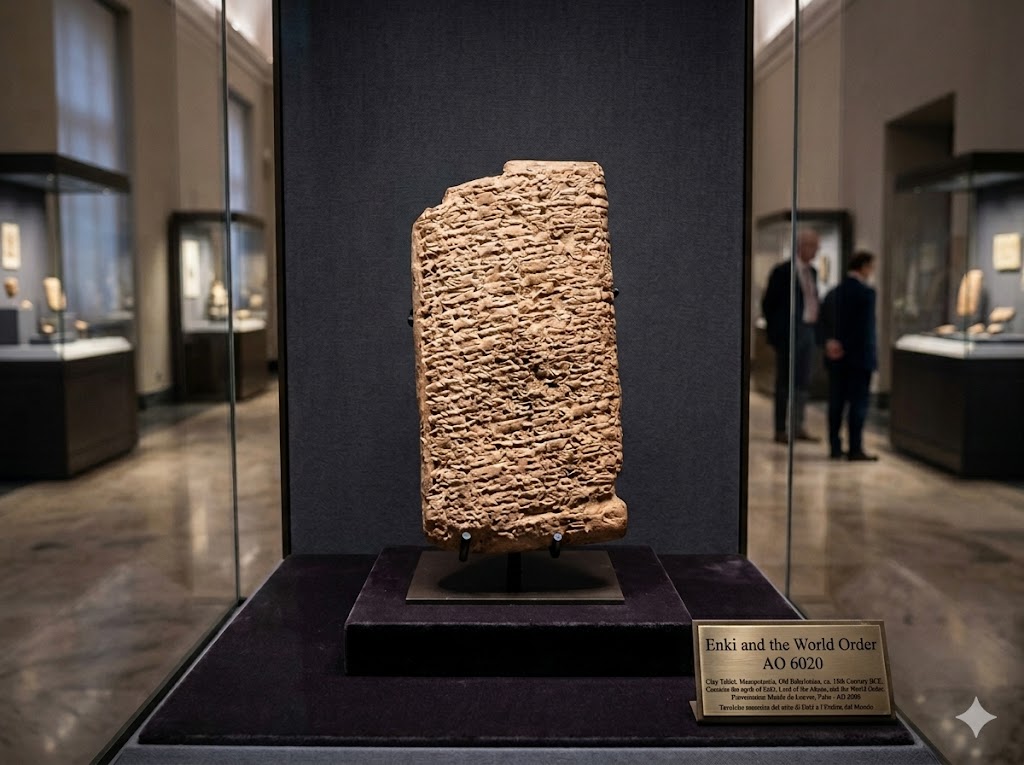
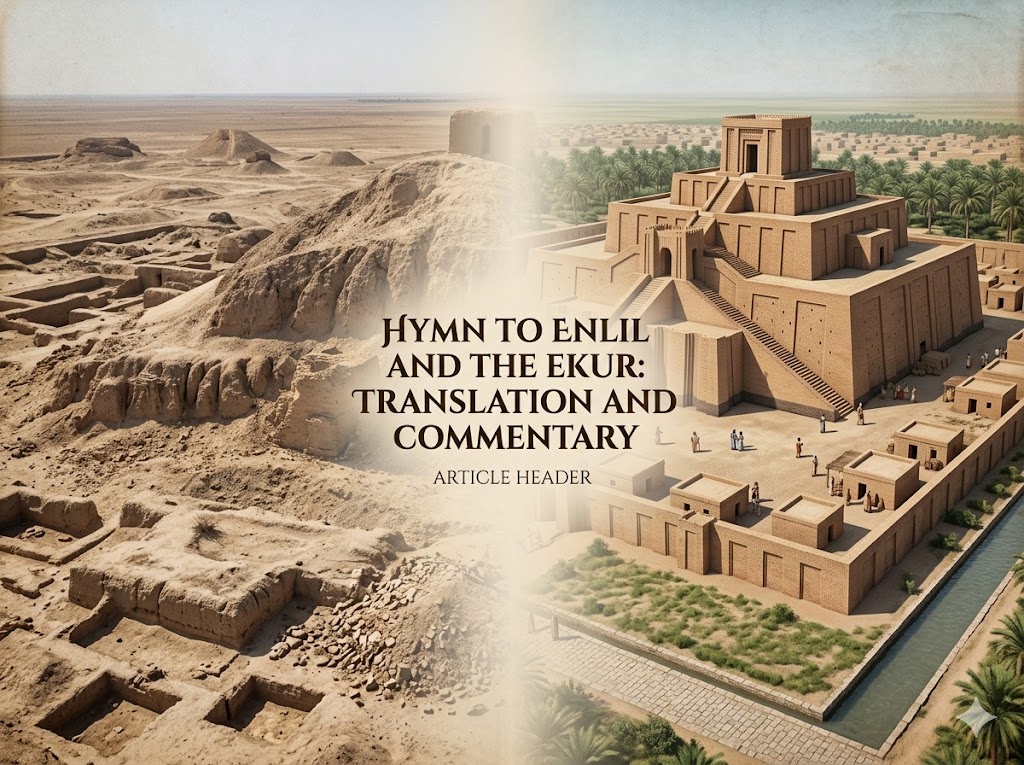
Enki and the World Order is a large Mesopotamian myth originally composed in the Sumerian language. It most likely developed within the scribal tradition associated with temples and priestly schools, where texts of this kind were copied, studied, and reworked for both liturgical and educational purposes. The work is generally dated to the early second millennium BCE, particularly to the Old Babylonian period; however, scholars agree that the poem preserves older conceptual layers, later reshaped in a more developed literary form. It likely reflects traditions that reach back at least to the Neo-Sumerian period, if not to even earlier phases of Sumerian culture (Black 1998–2006; Cooper 2024). The text is attested on several cuneiform tablets from different centers of southern Mesopotamia, including Nippur, one of the principal hubs for the transmission of Sumerian literature. It is also known through later copies preserved in Old Babylonian archives, evidence of its wide circulation and long-lasting influence (Black 1998–2006).
The myth belongs to the genre of Sumerian theogonic and cosmological literature, that is, the body of texts in which the gods define the structure of the cosmos and distribute powers and responsibilities, often in ways consistent with ritual needs and with what might be described as an “administrative” vision of the sacred. In Enki and the World Order, Enki—god of wisdom, of the abzu (the subterranean waters), and of ordering intelligence—does not create the world from nothing; rather, he makes it function. He assigns responsibilities, establishes divine roles, organizes natural and social domains, and sets in motion the proper balance between resources, institutions, and territories. Creation, in this sense, coincides with an act of ordering: what matters is the definition of functions and their placement within a stable system capable of guaranteeing prosperity and continuity (Cooper 2024).
Taken as a whole, the myth stands as a fundamental document of Mesopotamian religious culture because it shows, in narrative form, how the universe was conceived according to the model of a regulated order—a world in which stability is not automatic but depends on the correct assignment of roles and prerogatives. For this reason, the text also provides valuable testimony to the centrality of Enki as a mediating figure between the cosmic level (waters, fertility, primal forces) and the social level (cultic practices, divine hierarchies, and the management of the human world). It thus offers one of the most elaborate representations of the organization of reality according to the Sumerian worldview (Black 1998–2006; Cooper 2024).
Translation
1-16.
Grandiloquent lord of heaven and earth, self-reliant, Father Enki, engendered by a bull, begotten by a wild bull, cherished by Enlil, the Great Mountain, beloved by holy An, king, mec tree planted in the Abzu, rising over all lands; great dragon who stands in Eridug, whose shadow covers heaven and earth, a grove of vines extending over the Land, Enki, lord of plenty of the Anuna gods, Nudimmud, mighty one of the E-kur, strong one of heaven and earth! Your great house is founded in the Abzu, the great mooring-post of heaven and earth. Enki, from whom a single glance is enough to unsettle the heart of the mountains; wherever bison are born, where stags are born, where ibex are born, where wild goats are born, in meadows ……, in hollows in the heart of the hills, in green …… unvisited by man, you have fixed your gaze on the heart of the Land as on split reeds.
17-31.
Counting the days and putting the months in their houses, so as to complete the years and to submit the completed years to the assembly for a decision, taking decisions to regularise the days: Father Enki, you are the king of the assembled people. You have only to open your mouth for everything to multiply and for plenty to be established. Your branches …… green with their fruit ……, …… do honour to the gods. …… in its forests is like a fleecy garment. Good sheep and good lambs do honour to ……. When …… the prepared fields, …… will accumulate stockpiles and stacks. …… there is oil, there is milk, produced by the sheepfold and cow-pen. The shepherd sweetly sings his rustic song, the cowherd spends the day rocking his churns. Their products would do honour to the late lunches in the gods’ great dining hall.
32-37.
Your word fills the young man’s heart with vigour, so that like a thick-horned bull he butts about in the courtyard. Your word bestows loveliness on the young woman’s head, so that the people in their settled cities gaze at her in wonder.
2 lines unclear
38-47.
Enlil, the Great Mountain, has commissioned you to gladden the hearts of lords and rulers and wish them well. Enki, lord of prosperity, lord of wisdom, lord, the beloved of An, the ornament of Eridug, who establish commands and decisions, who well understands the decreeing of fates: you close up the days ……, and make the months enter their houses. You bring down ……, you have reached their number. You make the people dwell in their dwelling places ……, you make them follow their herdsman …….
2 lines unclear
50-51.
You turn weapons away from their houses ……, you make the people safe in their dwellings …….
52-60.
When Father Enki goes forth to the inseminated people, good seed will come forth. When Nudimmud goes forth to the good pregnant ewes, good lambs will be born; when he goes forth to the fecund cows, good calves will be born; whe he goes forth to the good pregnant goats, good kids will be born. If you go forth to the cultivated fields, to the good germinating fields, stockpiles and stacks can be accumulated on the high plain. If you go forth to the parched areas of the Land,
2 lines missing or unclear
61-80.
Enki, the king of the Abzu, rejoicing in great splendour, justly praises himself: “My father, the king of heaven and earth, made me famous in heaven and earth. My elder brother, the king of all the lands, gathered up all the divine powers and placed them in my hand. I brought the arts and crafts from the E-kur, the house of Enlil, to my Abzu in Eridug. I am the good semen, begotten by a wild bull, I am the first born of An. I am a great storm rising over the great earth, I am the great lord of the Land. I am the principal among all rulers, the father of all the foreign lands. I am the big brother of the gods, I bring prosperity to perfection. I am the seal-keeper of heaven and earth. I am the wisdom and understanding of all the foreign lands. With An the king, on An’s dais, I oversee justice. With Enlil, looking out over the lands, I decree good destinies. He has placed in my hands the decreeing of fates in the place where the sun rises. I am cherished by Nintur. I am named with a good name by Ninhursaja. I am the leader of the Anuna gods. I was born as the firstborn son of holy An.
81-83.
After the lord had proclaimed his greatness, after the great prince had eulogised himself, the Anuna gods stood there in prayer and supplication:
84-85.
“Praise be to Enki, the much-praised lord who controls all the arts and crafts, who takes decisions!”
86-88.
In a state of high delight Enki, the king of the Abzu, rejoicing in great splendour, again justly praises himself: “I am the lord, I am one whose word is reliable, I am one who excels in everything.”
89-99.
“At my command, sheepfolds have been built, cow-pens have been fenced off. When I approach heaven, a rain of abundance rains from heaven. When I approach earth, there is a high carp-flood. When I approach the green meadows, at my word stockpiles and stacks are accumulated. I have built my house, a shrine, in a pure place, and named it with a good name. I have built my Abzu, a shrine, in ……, and decreed a good fate for it. The shade of my house extends over the …… pool. By my house the suhur carp dart among the honey plants, and the ectub carp wave their tails among the small gizi reeds. The small birds chirp in their nests.
100-122.
“The lords pay heed …… to me. I am Enki! They stand before me, praising me. The abgal priests and abrig officials who …… stand before me …… distant days. The enkum and ninkum officiants organise ……. They purify the river for me, they …… the interior of the shrine for me. In my Abzu, sacred songs and incantations resound for me. My barge ‘Crown’, the ‘Stag of the Abzu’, transports me there most delightfully. It glides swiftly for me through the great marshes to wherever I have decided, it is obedient to me. The stroke-callers make the oars pull in perfect unison. They sing for me pleasant songs, creating a cheerful mood on the river. Nijir-sig, the captain of my barge, holds the golden sceptre for me. I am Enki! He is in command of my boat ‘Stag of the Abzu’. I am the lord! I will travel! I am Enki! I will go forth into my Land! I, the lord who determines the fates, ……,”
4 lines unclear
123-130.
“I will admire its green cedars. Let the lands of Meluha, Magan and Dilmun look upon me, upon Enki. Let the Dilmun boats be loaded (?) with timber. Let the Magan boats be loaded sky-high. Let the magilum boats of Meluha transport gold and silver and bring them to Nibru for Enlil, king of all the lands.”
131-133.
He presented animals to those who have no city, to those who have no houses, to the Martu nomads.
134-139.
The Anuna gods address affectionately the great prince who has travelled in his Land: “Lord who rides upon the great powers, the pure powers, who controls the great powers, the numberless powers, foremost in all the breadth of heaven and earth; who received the supreme powers in Eridug, the holy place, the most esteemed place, Enki, lord of heaven and earth — praise!”
140-161.
All the lords and rulers, the incantation-priests of Eridug and the linen-clad priests of Sumer, perform the purification rites of the Abzu for the great prince who has travelled in his land; for Father Enki they stand guard in the holy place, the most esteemed place. They …… the chambers ……, they …… the emplacements, they purify the great shrine of the Abzu ……. They bring there the tall juniper, the pure plant. They organise the holy …… in the great watercourse …… of Enki. Skilfully they build the main stairway of Eridug on the Good Quay. They prepare the sacred uzga shrine, where they utter endless prayers.
7 lines fragmentary or unclear
162-165.
For Enki, …… squabbling together, and the suhurmac carp dart among the honey plants, again fighting amongst themselves for the great prince. The ectub carp wave their tails among the small gizi reeds.
166-181.
The lord, the great ruler of the Abzu, issues instructions on board the ‘Stag of the Abzu’ — the great emblem erected in the Abzu, providing protection, its shade extending over the whole land and refreshing the people, the pillar and pole planted in the …… marsh, rising high over all the foreign lands. The noble captain of the lands, the son of Enlil, holds in his hand the sacred punt-pole, a mec tree ornamented in the Abzu which received the supreme powers in Eridug, the holy place, the most esteemed place. The hero proudly lifts his head towards the Abzu.
6 lines missing or unclear
182-187.
Sirsir ……, the boatman of the barge, …… the boat for the lord. Nijir-sig, the captain of the barge, holds the holy sceptre for the lord. The fifty lahama deities of the subterranean waters speak affectionately to him. The stroke-callers, like heavenly gamgam birds, …….
188-191.
The intrepid king, Father Enki …… in the Land. Prosperity was made to burgeon in heaven and on earth for the great prince who travels in the Land. Enki decreed its fate:
192-209.
“Sumer, great mountain, land of heaven and earth, trailing glory, bestowing powers on the people from sunrise to sunset: your powers are superior powers, untouchable, and your heart is complex and inscrutable. Like heaven itself, your just matrix, in which gods too can be born, is beyond reach. Giving birth to kings who put on the good diadem, giving birth to lords who wear the crown on their heads — your lord, the honoured lord, sits with An the king on An’s dais. Your king, the Great Mountain, Father Enlil, the father of all the lands, has blocked you impenetrably (?) like a cedar tree. The Anuna, the great gods, have taken up dwellings in your midst, and consume their food in your giguna shrines among the unique and exceptional trees. Household Sumer, may your sheepfolds be built and your cattle multiply, may your giguna touch the skies. May your good temples reach up to heaven. May the Anuna determine the destinies in your midst.”
210-211.
Then he proceeded to the sanctuary of Urim. Enki, lord of the Abzu, decreed its fate:
212-218.
“City which possesses all that is fitting, bathed by water! Sturdy bull, altar of abundance that strides across the mountains, rising like the hills, forest of hacur cypresses with broad shade, self-confident! May your perfect powers be well-directed. The Great Mountain Enlil has pronounced your name great in heaven and on earth. City whose fate Enki has decreed, sanctuary of Urim, you shall rise high to heaven!”
219-220.
Then he proceeded to the land of Meluha. Enki, lord of the Abzu, decreed its fate:
221-237.
“Black land, may your trees be great trees, may your forests be forests of highland mec trees! Chairs made from them will grace royal palaces! May your reeds be great reeds, may they ……! Heroes shall …… them on the battlefield as weapons! May your bulls be great bulls, may they be bulls of the mountains! May their bellowing be the bellowing of wild bulls of the mountains! The great powers of the gods shall be made perfect for you! May the francolins of the mountains wear cornelian beards! May your birds all be peacocks! May their cries grace royal palaces! May all your silver be gold! May all your copper be tin-bronze! Land, may all you possess be plentiful! May your people ……! May your men go forth like bulls against their fellow men!”
2 lines unclear
238-247.
He cleansed and purified the land of Dilmun. He placed Ninsikila in charge of it. He gave …… for the fish spawn, ate its …… fish, bestowed palms on the cultivated land, ate its dates. …… Elam and Marhaci ……. …… to devour ……. The king endowed with strength by Enlil destroyed their houses, demolished (?) their walls. He brought their silver and lapis-lazuli, their treasure, to Enlil, king of all the lands, in Nibru.
248-249.
Enki presented animals to those who have no city, who have no houses, to the Martu nomads.
250-266.
After he had turned his gaze from there, after Father Enki had lifted his eyes across the Euphrates, he stood up full of lust like a rampant bull, lifted his penis, ejaculated and filled the Tigris with flowing water. He was like a wild cow mooing for its young in the wild grass, its scorpion-infested cow-pen. The Tigris …… at his side like a rampant bull. By lifting his penis, he brought a bridal gift. The Tigris rejoiced in its heart like a great wild bull, when it was born ……. It brought water, flowing water indeed: its wine will be sweet. It brought barley, mottled barley indeed: the people will eat it. It filled the E-kur, the house of Enlil, with all sorts of things. Enlil was delighted with Enki, and Nibru was glad. The lord put on the diadem as a sign of lordship, he put on the good crown as a sign of kingship, touching the ground on his left side. Plenty came forth out of the earth for him.
267-273.
Enki, the lord of the destinies, Enki, the king of the Abzu, placed in charge of all this him who holds a sceptre in his right hand, him who with glorious mouth submits to verification the devouring force of the Tigris and Euphrates, while prosperity pours forth from the palace like oil — Enbilulu, the inspector of waterways.
274-277.
He called the marshes and gave them the various species of carp, he spoke to the reedbeds and bestowed on them the old and new growths of reeds.
2 lines missing
278-284.
He issued a challenge ……. Enki placed in charge of all this him from whose net no fish escapes, him from whose trap no living thing escapes, him from whose bird-net no bird escapes,
1 line unclear
— ……, who loves fish.
285-298.
The lord established a shrine, a holy shrine, whose interior is elaborately constructed. He established a shrine in the sea, a holy shrine, whose interior is elaborately constructed. The shrine, whose interior is a tangled thread, is beyond understanding. The shrine’s emplacement is situated by the constellation the Field, the holy upper shrine’s emplacement faces towards the Chariot constellation. Its terrifying sea is a rising wave, its splendour is fearsome. The Anuna gods dare not approach it. …… to refresh their hearts, the palace rejoices. The Anuna stand by with prayers and supplications. They set up a great altar for Enki in the E-engura, for the lord ……. The great prince ……. …… the pelican of the sea.
1 line unclear
299-308.
He filled the E-kur, the house of Enlil, with goods of all sorts. Enlil was delighted with Enki, and Nibru was glad. Enki placed in charge of all this, over the wide extent of the sea, her who sets sail …… in the holy shrine, who induces sexual intercourse ……, who …… over the enormous high flood of the subterranean waters, the terrifying waves, the inundation of the sea ……, who comes forth from the ……, the mistress of Sirara, …… — Nance.
309-317.
He called to the rain of the heavens. He …… as floating clouds. He made …… rising at the horizon. He turned the mounds into fields ……. Enki placed in charge of all this him who rides on the great storms, who attacks with lightning bolts, the holy bar which blocks the entrance to the interior of heaven, the son of An, the canal inspector of heaven and earth — Ickur, the bringer of plenty, the son of An.
318-325.
He organised ploughs, yokes and teams. The great prince Enki bestowed the horned oxen that follow the …… tools, he opened up the holy furrows, and made the barley grow on the cultivated fields. Enki placed in charge of them the lord who wears the diadem, the ornament of the high plain, him of the implements, the farmer of Enlil — Enkimdu, responsible for ditches and dykes.
326-334.
The lord called the cultivated fields, and bestowed on them mottled barley. Enki made chickpeas, lentils and …… grow. He heaped up into piles the early, mottled and innuha varieties of barley. Enki multiplied the stockpiles and stacks, and with Enlil’s help he enhanced the people’s prosperity. Enki placed in charge of all this her whose head and body are dappled, whose face is covered in syrup, the mistress who causes sexual intercourse, the power of the Land, the life of the black-headed — Ezina, the good bread of the whole world.
335-340.
The great prince fixed a string to the hoe, and organised brick moulds. He penetrated the …… like precious oil. Enki placed in charge of them him whose sharp-bladed hoe is a corpse-devouring snake that ……, whose brick mould in place is a tidy stack of hulled grain for the ewes — Kulla, who …… bricks in the Land.
341-348.
He tied down the strings and coordinated them with the foundations, and with the power of the assembly he planned a house and performed the purification rituals. The great prince put down the foundations, and laid the bricks. Enki placed in charge of all this him whose foundations once laid do not sag, whose good houses once built do not collapse (?), whose vaults reach up into the heart of the heavens like a rainbow — Mucdama, Enlil’s master builder.
349-357.
He raised a holy crown over the upland plain. He fastened a lapis-lazuli beard to the high plain, and made it wear a lapis-lazuli headdress. He made this good place perfect with greenery in abundance. He multiplied the animals of the high plain to an appropriate degree, he multiplied the ibex and wild goats of the pastures, and made them copulate. Enki placed in charge of them the hero who is the crown of the high plain, who is the king of the countryside, the great lion of the high plain, the muscular, the hefty, the burly strength of Enlil — Cakkan, the king of the hills.
358-367.
He built the sheepfolds, carried out their cleaning, made the cow-pens, bestowed on them the best fat and cream, and brought luxury to the gods’ dining places. He made the plain, created for greenery, achieve prosperity. Enki placed in charge of all this the king, the good provider of E-ana, the friend of An, the beloved son-in-law of the youth Suen, the holy spouse of Inana the mistress, the lady of the great powers who allows sexual intercourse in the open squares of Kulaba — Dumuzid-ucumgal-ana, the friend of An.
368-380.
He filled the E-kur, the house of Enlil, with possessions. Enlil was delighted with Enki and Nibru was glad. He demarcated borders and fixed boundaries. For the Anuna gods, Enki situated dwellings in cities and disposed agricultural land into fields. Enki placed in charge of the whole of heaven and earth the hero, the bull who comes out of the hacur forest bellowing truculently, the youth Utu, the bull standing triumphantly, audaciously, majestically, the father of the Great City (an expression for the underworld) , the great herald in the east of holy An, the judge who searches out verdicts for the gods, with a lapis-lazuli beard, rising from the horizon into the holy heavens — Utu, the son born by Ningal.
381-386.
He picked out the tow from the fibres, and set up the loom. Enki greatly perfected the task of women. For Enki, the people …… in …… garments. Enki placed in charge of them the honour of the palace, the dignity of the king — Uttu, the conscientious woman, the silent one.
387-390.
Then, alone lacking any functions, the great woman of heaven, Inana, lacking any functions — Inana came in to see her father Enki in his house, weeping to him, and making her complaint to him:
391-394.
“Enlil left it in your hands to confirm the functions of the Anuna, the great gods. Why did you treat me, the woman, in an exceptional manner? I am holy Inana — where are my functions?”
395-402.
“Aruru, Enlil’s sister, Nintur, the lady of giving birth, is to get the holy birth-bricks as her prerogative. She is to carry off the lancet for umbilical cords, the special sand and leeks. She is to get the sila-jara bowl of translucent lapis lazuli (in which to place the afterbirth) . She is to carry off the holy consecrated ala vessel. She is to be the midwife of the land! The birthing of kings and lords is to be in her hands.”
403-405.
“My illustrious sister, holy Ninisina, is to get the jewellery of cuba stones. She is to be the mistress of heaven. She is to stand beside An and speak to him whenever she desires.”
406-411.
“My illustrious sister, holy Ninmug, is to get the golden chisel and the silver burin. She is to carry off her big flint antasura blade. She is to be the metal-worker of the Land. The fitting of the good diadem when a king is born and the crowning with the crown when a lord is born are to be in her hands.
412-417.
“My illustrious sister, holy Nisaba, is to get the measuring-reed. The lapis-lazuli measuring tape is to hang over her arm. She is to proclaim all the great powers. She is to demarcate boundaries and mark borders. She is to be the scribe of the Land. The planning of the gods’ meals is to be in her hands.”
418-421.
“Nance, the august lady, who rests her feet on the holy pelican, is to be the fisheries inspector of the sea. She is to be responsible for accepting delectable fish and delicious birds from there to go to Nibru for her father Enlil.
422-423.
“But why did you treat me, the woman, in an exceptional manner? I am holy Inana — where are my functions?”
424-436.
Enki answered his daughter, holy Inana : “How have I disparaged you? Goddess, how have I disparaged you? How can I enhance you? Maiden Inana, how have I disparaged you? How can I enhance you? I made you speak as a woman with pleasant voice. I made you go forth ……. I covered …… with a garment. I made you exchange its right side and its left side. I clothed you in garments of women’s power. I put women’s speech in your mouth. I placed in your hands the spindle and the hairpin. I …… to you women’s adornment. I settled on you the staff and the crook, with the shepherd’s stick beside them.”
437-444.
“Maiden Inana, how have I disparaged you? How can I enhance you? Amongst the ominous ocurrences in the hurly-burly of battle, I shall make you speak vivifying words; and in its midst, although you are not an arabu bird”(a bird of ill omen) , I shall make you speak ill-omened words also. I made you tangle straight threads; maiden Inana, I made you straighten out tangled threads. I made you put on garments, I made you dress in linen. I made you pick out the tow from the fibres, I made you spin with the spindle. I made you colour tufted (?) cloth with coloured threads.
445-450.
“Inana, you heap up human heads like piles of dust, you sow heads like seed. Inana, you destroy what should not be destroyed; you create what should not be created. You remove the cover from the cem drum of lamentations, Maiden Inana, while shutting up the tigi and adab instruments in their homes. You never grow weary with admirers looking at you. Maiden Inana, you know nothing of tying the ropes on deep wells.”
451-471.
“But now, the heart has overflowed, the Land is restored; Enlil’s heart has overflowed, the Land is restored. In his overflowing heart of mankind,”
4 lines unclear
“…… lapis-lazuli headdress …… is your prerogative, …… is your prerogative, …… is your prerogative, …… is your prerogative.”
10 lines unclear
472.
Praise be to Father Enki.
Electronic Text Corpus of Sumerian Literature (ETCSL),
Enki and the World Order (t.1.1.3) University of Oxford.
https://etcsl.orinst.ox.ac.uk/cgi-bin/etcsl.cgi?text=t.1.1.3&charenc=j
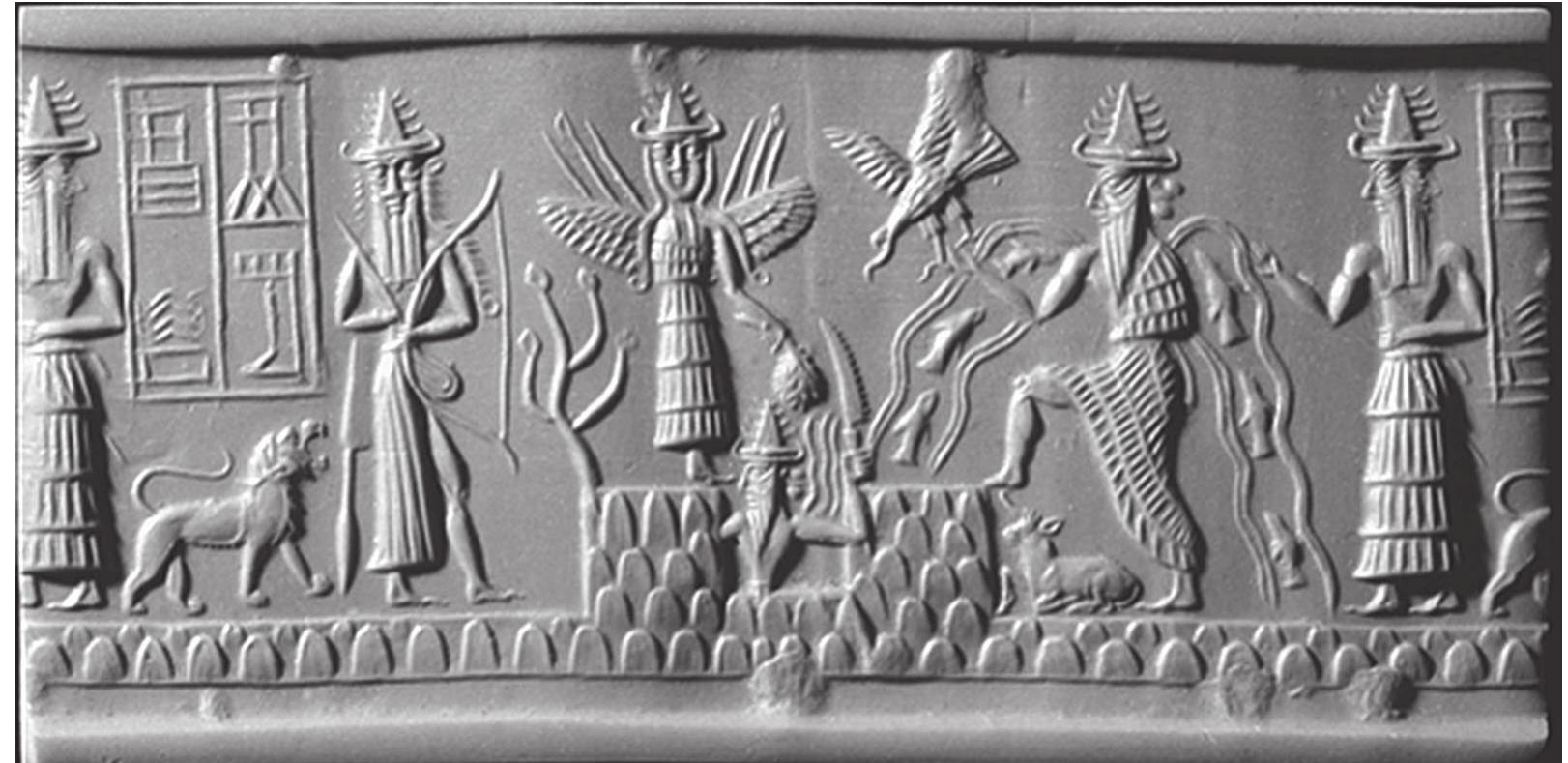
Table of Terms
| Term | Description | |
| “black-headed” (“teste nere”) | Sumerian expression referring to human beings (the Sumerians themselves): “the black-headed people.” | |
| Abzu / Abzû | Subterranean ocean of fresh water, the primordial reservoir from which rivers and springs arise; dwelling place of Enki. | |
| adab | “Adab song”: a genre of hymn; here referring to a ritual musical ensemble or chant. | |
| ala (ala vessel) | Sacred “consecrated” vessel used in rituals (in this case associated with childbirth). | |
| An | Sky god, head of the pantheon; father of Enlil and Enki in many traditions. | |
| Anuna / Anuna gods | “Descendants of An”; the great assembly of major gods (Anunnaki), the divine council that decrees destinies. | |
| arabu (arabu bird) | Bird considered a bad omen; Inana is not an arabu, but she can pronounce ominous words. | |
| Aruru | Sister of Enlil, goddess associated with the formation of humankind, creation, and childbirth. | |
| Dilmun | “Pure” land, often associated with Bahrain; an important trade hub and semi-paradisiacal place. | |
| Dumuzid-ušumgal-ana | Aspect of Dumuzid (Tammuz), the divine shepherd and consort of Inana; here connected with pastoral life and divine banquets. | |
| E-ana (É.ANNA) | “House of Heaven”: the great temple of Inana at Uruk; Dumuzid is described as the “good provider of E-ana.” | |
| E-engura | Sanctuary associated with the Abzu and with Enki, linked to the deep waters and the decreeing of destinies. | |
| E-kur | Literally “House-Mountain”; the great temple of Enlil at Nibru (Nippur), center of the divine council. | |
| Elam | Region east of Mesopotamia (modern southwestern Iran); often a rival, sometimes an ally. | |
| Enbilulu | Deity associated with the control of rivers and canals, “inspector of watercourses” (Tigris and Euphrates). | |
| Enki | Great Sumerian god of the subterranean fresh waters (Abzu), wisdom, magic, crafts, and creation; associated with Eridug (Eridu). | |
| Enkimdu | “Farmer of Enlil,” deity of irrigation, canals, and agriculture. | |
| Enlil | God of air and atmosphere, of sovereignty; the “Great Mountain,” lord of the E-kur at Nippur (Nibru). | |
| Eridug / Eridu | One of the oldest cities of southern Mesopotamia; principal cult center of Enki. | |
| eštub (eštub carp) | A species of carp mentioned in contexts describing abundance of water. | |
| Ezina (Ashnan) | Goddess of grain and bread; described here as the “good bread of the whole world.” | |
| gamgam (gamgam birds) | Mythic or celestial birds evoked to describe the rhythmic voices of rowers. | |
| giguna | Type of sacred building or temple wing where the gods consume their food. | |
| gizi (gizi reed) | Type of reed or rush growing in marshlands. | |
| hašur (hašur cypress) | A type of mountain cypress used as valuable timber. | |
| Inana | Goddess of love, desire, war, and royal power (Akkadian: Ishtar). | |
| Iškur | God of storms and thunder (Akkadian: Adad), bringer of rain and abundance. | |
| Kulla | God of bricks and construction; supervisor of brick production. | |
| Magan | Region probably located in the Oman / coastal Arabia area, famous for copper and timber. | |
| Marḫaši | Eastern territory rich in resources, not precisely identified; often described as a distant land. | |
| me | Not explicitly written here but implied: the “divine powers / functions / decrees” that An and Enlil place in the hands of Enki and other gods. | |
| Meluḫa | Distant region probably connected with the Indus Valley; source of gold, precious stones, and wood. | |
| meš (meš tree) | Sacred or prestigious tree species (not certainly identified), used as pole, beam, or punting pole; symbol of strength and stability. | |
| Mušdama | Master builder of Enlil, god of foundations and architectural planning of houses and temples. | |
| Nanše | Goddess associated with social justice, orphans, fish, and waters; here “inspector of the sea’s fisheries.” | |
| Nibru (Nippur) | Sacred city of Enlil, location of the E-kur and center of divine destinies. | |
| Ninhursaĝa (Ninḫursaĝa) | Great mother goddess, “Lady of the Mountain”; goddess of fertility, motherhood, and nature. | |
| Ninisina | Goddess of medicine and healing, often associated with the city of Isin. | |
| Ninmug | Goddess of metallurgy and metalworking. | |
| Ninsikila | Deity associated with Dilmun; appointed by Enki as leader of the land of Dilmun. | |
| Nintur | Aspect of the mother goddess (Aruru), lady of childbirth and creator of humanity; associated with births and royal destinies. | |
| Nintur / Ninisina / Ninmug / Nisaba | Series of specialized goddesses: Nintur (childbirth), Ninisina (healing), Ninmug (metalwork), Nisaba (writing and measurement). | |
| Nisaba | Goddess of writing, calculation, measures, and administrative wisdom. | |
| Nudimmud | Epithet of Enki meaning “fashioner / creator,” “the one who shapes the image.” | |
| Šakkan (Šakkan / Sumuqan) | God of herds and steppe animals, “king of the hills.” | |
| šem (šem drum) | Type of drum used in lamentation songs. | |
| sila-ĝara | Type of cup or vessel (capacity measure) of lapis lazuli; here used for the placenta (a ritual obstetric object). | |
| Sirara | Region or place of waters associated with Nanše, “the lady of Sirara.” | |
| Suen / Nanna | Moon god, patron of Ur (Urim), often linked with kingship. | |
| suḫur (suḫur carp) | Species of carp symbolizing aquatic abundance of the Abzu. | |
| suḫurmaš (suḫurmaš carp) | Fish species (carp) that “leaps among the honey plants,” metaphor of vitality within the Abzu. | |
| Sumer | Historical region of southern Mesopotamia; here personified as the “great mountain” that produces kings and lords. | |
| tigi | Musical instrument (perhaps a lyre or harp) used in hymns and praises. | |
| Urim (Ur) | Major Sumerian city-state; sanctuary of the moon god Nanna (Suen). | |
| Uttu | Goddess of weaving and women’s crafts: loom, spinning, and textile production. | |
| Utu | God of the sun and justice (Akkadian: Shamash); supreme judge and guarantor of law and order. | |
| uzga | Term for a specific sanctuary, a place for prayers and rituals. |
Textual Analysis
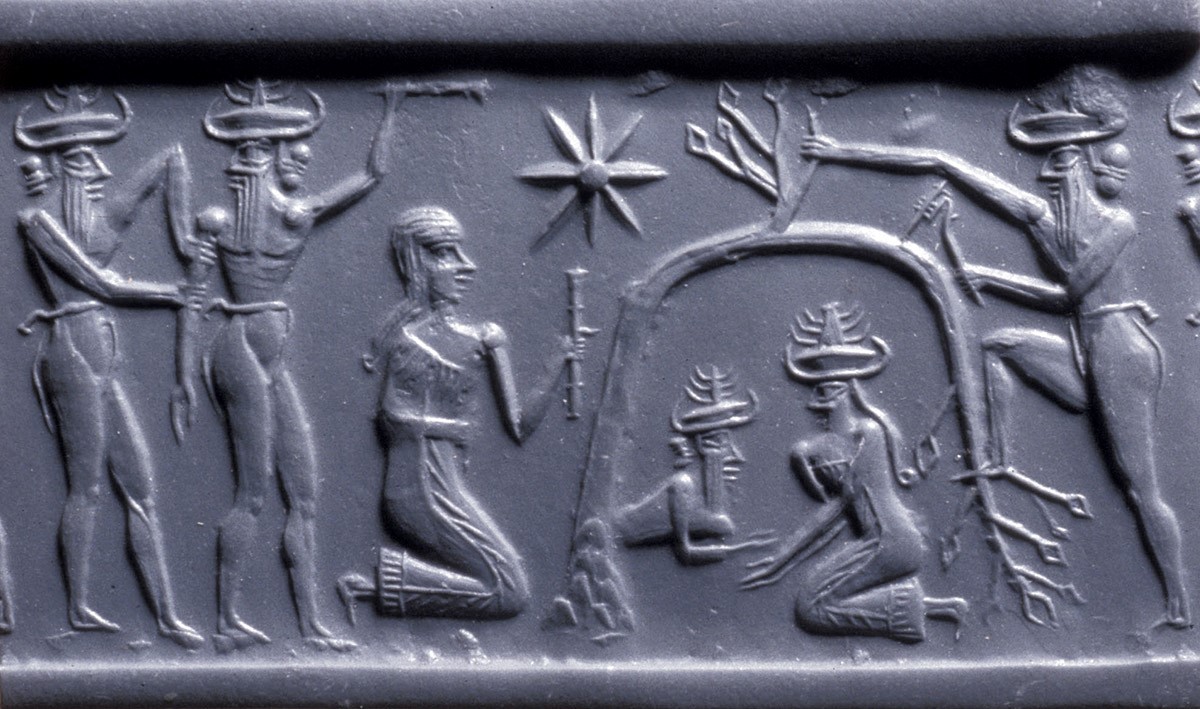
At the beginning of the text (1–16), Enki is celebrated through powerful imagery: he is “begotten by a bull, conceived by a wild bull,” a “great dragon” who dwells in the sacred city of Eridug, and a “meš tree planted in the Abzu.” The bull and the dragon are two symbols of primordial strength: the bull evokes sexual vitality and royal power, while the dragon, in Mesopotamian imagery, is often a gigantic and liminal creature associated with the waters and the boundaries of the cosmos, not necessarily malevolent as in later medieval traditions (Jacobsen 1976).
The image of the meš tree planted in the Abzu—the subterranean ocean of fresh water—presents Enki as a living axis linking the deep waters to the surface of the earth and the heavens. His “house” is not located in an ordinary place, but at the point of junction between the levels of the cosmos. The Abzu itself is described as the “great mooring post of heaven and earth,” as if the world were a vessel that must be anchored by a divine fastening lest it slip back into chaos (Black & Green 1992).
This sovereignty is not abstract. The text insists that Enki’s gaze reaches even the wildest regions: the places where bison, deer, ibex, and wild goats are born, in the hollows of hills never visited by humans. Nothing escapes his eye. Untamed nature does not lie outside his order; it is “seen,” and thus implicitly brought under discipline. The comparison with *“broken reeds”—*fragile and easily bent—suggests that even the “heart of the Earth” is vulnerable before the power of the god.
Immediately afterward (17–31), the focus shifts from the cosmic landscape to time and everyday life. Enki is the god who “counts the days and assigns the months their places,” who completes the years and presents them before the assembly of the gods for decision. The image is remarkably refined: behind it lies the idea that the calendar—with its lunar months, intercalary years, and festivals—is not merely a human invention but a divine institution. If Enki did not “set the days in order,” time itself would fall out of rhythm, and agriculture, offerings, and rituals would occur at the wrong moment (Jacobsen 1976; Kramer 1961).
The text immediately connects this temporal order with tangible prosperity: oil, milk, sheep and lambs, prepared fields producing “supplies and heaps,” shepherds and herdsmen singing as they work. The picture is almost idyllic: peace (Enki “drives weapons away from the houses”) and abundance converge in the image of a stable rural society.
The fertility for which Enki is responsible is not only social but also biological and cosmic (52–60). Wherever Enki/Nudimmud goes, “good lambs,” “good calves,” and “good kids” are born. Wherever he enters the germinating fields, stores accumulate upon the highlands. The generative energy is one and the same: it flows from the waters to the wombs of animals and to the seeds of the fields. In this respect, Enki’s figure is typical of the great Mesopotamian gods of fresh waters: the subterranean waters are the reservoir of life that nourishes everything that grows (Black & Green 1992).
At this point the myth introduces a strongly theological section (61–88): Enki himself speaks and praises his own greatness. He claims an exalted origin (“I am the firstborn of An”), a prominent position (“the elder brother of the gods”), and a central role in the management of divine authority. The kingly father of heaven and earth (An) has made him renowned, while the elder brother Enlil has placed in his hands all the divine powers.
Significantly, Enki does not present himself as a god who rules through brute force, but as one who administers destinies: “I am the keeper of the seal of heaven and earth,” “with Enlil I decree favorable destinies,” “to me is entrusted the decreeing of destinies in the place where the sun rises.” Behind this rhetoric stands the Sumerian concept of me, the “powers” or “functions” that structure the cosmos and its institutions. The text evokes them here without naming them explicitly, portraying them instead as a bundle of competencies placed in Enki’s hands (Kramer 1963; Cooper 2024).
This self-praise does not remain isolated. The Anuna—the great divine council—enter into prayer and acclaim him as the “greatly praised lord who governs all arts and crafts.” His word is described as “trustworthy” and “excellent in everything.” The underlying idea is that Enki’s speech does not merely describe reality but brings it into being. It is performative speech, capable of giving existence to structures and institutions (Jacobsen 1976).
The description of Enki’s sanctuary and its surroundings (89–122) gives tangible form to this ordering power within a small cultic microcosm. Enki has built his dwelling in a pure place and established the Abzu as his sanctuary. Around it, suḫur and eštub carp swim among “honey plants” and gizi reeds, while small birds chirp in their nests. The scene is almost pastoral, yet it also carries a theological meaning: the temple is not merely a building but a miniature model of a well-ordered world, where each species occupies its proper place and everything exists in harmony (Black & Green 1992; Black 1998–2006).
The divine boat “Crown” or “Stag of the Abzu,” with its captain and rowers singing in unison, evokes the ritual water processions in which divine statues were transported from one temple to another. In this context the boat itself becomes an emblem of Enki’s dominion over rivers and marshlands.
From here the myth expands to encompass geography. Enki proclaims that he will gaze upon the “green cedars” and that the lands of Meluḫa, Magan, and Dilmun will behold him (123–130). These names are not imaginary locations: archaeologists connect them with real regions—the Indus Valley (Meluḫa), Oman and the Arabian coasts (Magan), and Bahrain and its surroundings (Dilmun)—all involved in long-distance trade networks for timber, metals, and precious stones (Potts 1982; Potts 1993). Ships from these lands carry wood, gold, and silver to Nippur for Enlil. In this way the myth offers a theological interpretation of international commerce: economic routes are portrayed as channels through which wealth ultimately returns to the gods, especially to the cultic system centered on Enlil and Enki.
Not only Sumer and Urim, but also foreign lands receive a “destiny” decreed by the god. The “black land” of Meluḫa is blessed with trees, reeds, mountain bulls, peacocks, and metals transformed into valuable alloys—tin bronze and silver refined into gold. Dilmun is purified and entrusted to Ninsikila. Elam and Marḫaši, by contrast, are devastated, their treasures carried away to Nibru. Beneath the surface, the myth preserves a memory of real political and economic dynamics: lands integrated into networks of exchange and lands subdued or dominated, all reinterpreted as the result of divine decisions (Potts 1993; Cooper 2024). In elegant form the text conveys a clear message: Mesopotamian supremacy and the circulation of wealth possess a sacred foundation.
One of the most famous episodes is the moment when Enki, after “lifting his eyes beyond the Euphrates,” stands up “filled with libido like a raging bull,” raises his penis, and fills the Tigris with flowing water (250–266). The passage is deliberately explicit, yet many scholars interpret it as a transparent metaphor: the divine seed is the water that irrigates the earth. The flood of the Tigris, described like a joyous wild bull, brings fresh water, variegated barley, and goods that fill Enlil’s E-kur. The sexual pleasure of the god becomes hydraulic fertility and agricultural abundance (Böck 2018; Zare 2022). The appointment of Enbilulu as inspector of the watercourses formalizes this order: even rivers, like human professions, are entrusted to a specialized divine official.
From this point onward, the text unfolds almost like a long list of ministries assigned by Enki. Over the sea and the fisheries he appoints Nanše; over storms and rain, Iškur; over irrigated fields and canals, Enkimdu; over grain and bread, Ezina; over bricks, Kulla; over construction and foundations, Mušdama; over the animals of the hills, Šakkan; over flocks, banquets, and the pastoral sphere, Dumuzid-ušumgal-ana; over solar judgment and justice, Utu; and over weaving and women’s work, Uttu (285–380). Barbara Böck has shown that this section of the myth can be read as a narrative about the emergence of social institutions: each “sector” of Mesopotamian life—fishing, agriculture, construction, writing, childbirth, weaving—is linked to a foundational act of Enki and entrusted to a deity representing that function (Böck 2021). In other words, the myth functions almost like a “cosmic constitution”: it defines who is responsible for what at the divine level, thereby legitimizing the concrete organization of society.
A particularly interesting aspect of the text is the way it addresses the question of gender. In the section concerning Uttu (381–386), we see Enki “setting the loom” and perfecting women’s work, before entrusting it to a goddess. Weaving, a typically female activity, thus originates from Enki’s wisdom but is personified in a female deity. Finely woven garments, moreover, form part of the “dignity of the king”: women’s work is therefore placed at the very heart of royal representation.
It is precisely at this point that Inana enters the scene (387–471), the “great woman of heaven,” who appears as the only deity without clearly defined functions. She approaches Enki in tears and protests: “Why have you treated me, the woman, in such an exceptional way? I am the holy Inana — where are my functions?” It is a narratively powerful moment: all the other goddesses—Aruru/Nintur for childbirth, Ninisina for healing and jewelry, Ninmug for metallurgy, Nisaba for writing and measurement, Nanše for fishing—have received a clearly defined sphere of competence. Inana has not.
Enki’s reply is deliberately ambiguous. On the one hand, he insists that he has not diminished her at all: he has given her a pleasing voice, garments of feminine power, a spindle and hairpin, a staff and a shepherd’s crook. In other words, he acknowledges both her seductive authority and a form of quasi-regal status. On the other hand, he emphasizes her darker side: Inana “heaps up human heads like piles of dust,” “sows heads like seed,” “destroys what should not be destroyed and creates what should not be created,” and “opens the drum of lamentations while silencing other instruments.” She is the goddess of love and war at once, of emotional excess and reversal (Böck 2004). Unlike the other functional deities, Inana embodies something that resists classification: she cannot be reduced to a single “ministry.”
The text is fragmentary toward the end, but we glimpse a resolution: after the statement that “the heart has overflowed, the Earth has been restored,” Inana is granted prerogatives symbolized by a headdress of lapis lazuli. This suggests that the conflict ends with a form of institutional recognition. If the world has been restored, then Inana’s ambivalent energy must also be integrated into the cosmic order—without, however, removing its inherent danger.
Taken as a whole, the myth performs several functions. It is a hymn to Enki as lord of wisdom, of the waters, and of temporal and institutional order. It is also a “secondary” cosmogony: rather than narrating the absolute beginning of the world, it describes the reorganization of the cosmos after an implicit catastrophe, as Cooper has suggested (Cooper 2024). At the same time, it acts as a theological charter of institutions: professions, functions, boundaries, cities, and foreign lands are all woven into a network of divine responsibilities. Finally, it is a narrative that stages tensions within the pantheon—particularly between the rational ordering power of Enki and the charismatic, uncontrollable force of Inana—showing that the order of the world is never a closed, perfect, and static system, but something that must continually negotiate with conflict, desire, and excess.
In summary, Enki and the World Order:
- Celebrates Enki as the god of water, wisdom, and order — “source and center of human activity and natural order” (Jacobsen 1976).
- Describes the establishment of cosmic and social order: rivers, rains, the sea, animals, fields, and cities; professions (farmers, builders, weavers, fishermen); and political roles (kings, rulers, boundaries).
- Functions as a theological charter of institutions: every key sector of Mesopotamian life is traced back to a decision of Enki and entrusted to a specific functional deity (Böck 2021; Cooper 2024).
- Stages an internal conflict within the pantheon (Enki vs. Inana) over the distribution of functions, suggesting that order is never completely “closed,” but must continually contend with forces that exceed
Bibliography
- Black, J. et al. 1998-2006, Electronic Text Corpus of Sumerian Literature (ETCSL).
- Black, J. & Green, A. 1992, Gods, Demons and Symbols of Ancient Mesopotamia.
- Böck, B. 2021, “Explaining the Emergence of Social Institutions in Ancient Mesopotamia: The Sumerian Myth Enki and the World Order”.
- Cooper, J. S. 2024, Enki and the World Order. A Sumerian Myth.
- Jacobsen, T. 1976, The Treasures of Darkness. A History of Mesopotamian Religion.
- Kramer, S. N. 1961, Sumerian Mythology; 1963, The Sumerians.
- Potts, D. T. 1982, “The Road to Meluhha”; 1993, “Patterns of Trade in Third-Millennium BC Mesopotamia”.

Comments (0)