

This text is taken from the book
“The sumerian mith translated and commented.
with a glossary of terms”
View the book index and description

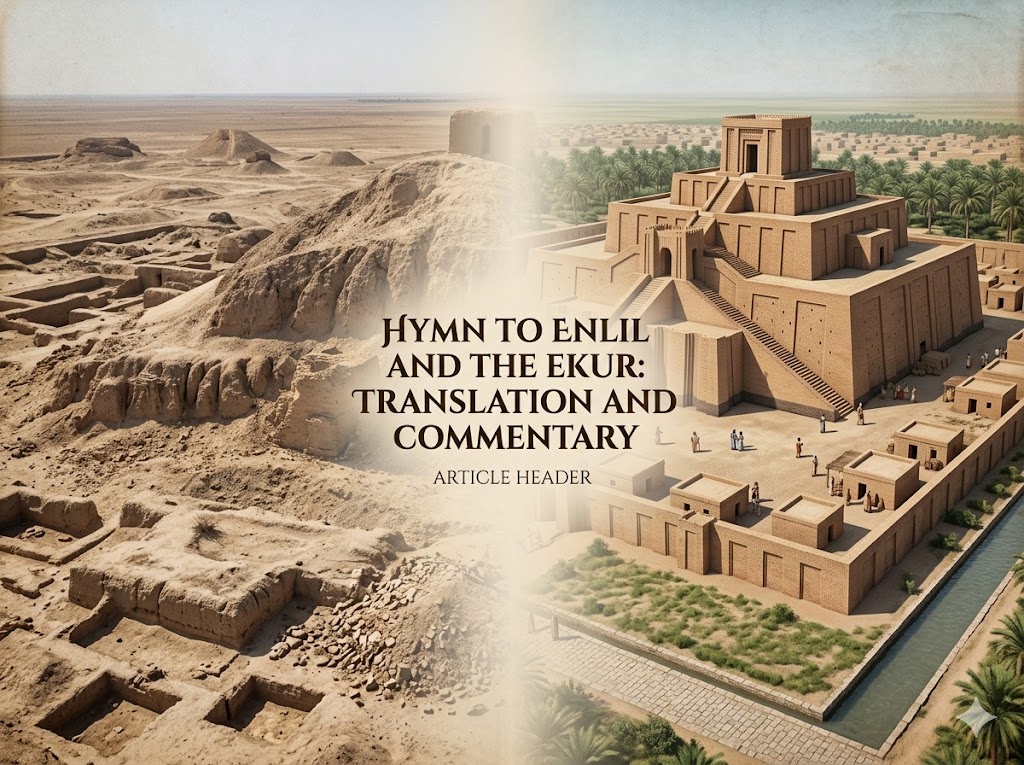
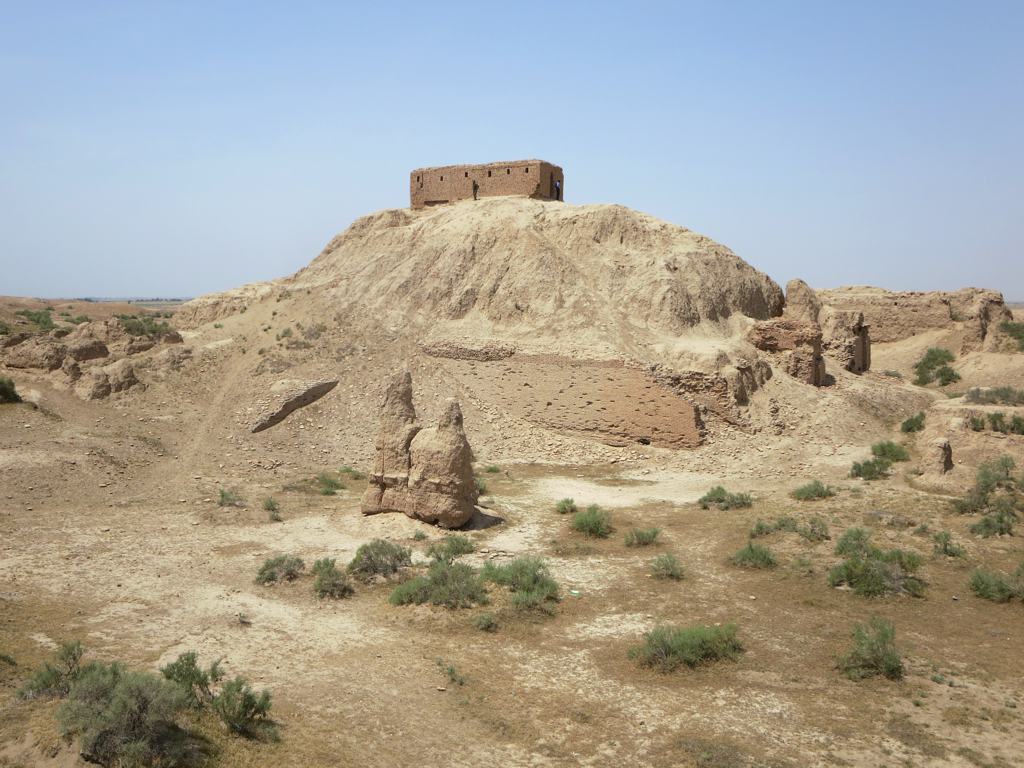
The Hymn to Enlil and the E-kur belongs to the religious tradition of ancient Mesopotamia and is composed in the Sumerian language. It is generally dated to the Old Babylonian period (approximately the nineteenth–eighteenth centuries BCE), although it reflects religious conceptions that had already developed during the earlier Sumerian era. The text has come down to us through clay tablets discovered primarily in the city of Nippur, in present-day central Iraq, which was regarded as the principal cult center of the god Enlil.
At the symbolic heart of the hymn stands the E-kur, the great temple of Enlil at Nippur, often described as the “house-mountain.” The E-kur is portrayed as the point of contact between heaven and earth, the Duranki, the cosmic “bond” where the destinies of the world are determined. The temple is not merely a building but the center of universal order: from it depend on justice, the stability of cities, the fertility of the fields, and the prosperity of humankind.
The composition is a cultic hymn of praise, most likely intended for liturgical recitation within a temple setting. It celebrates the figure of Enlil, called the “Great Mountain,” sovereign of the gods and guarantor of cosmic order, while at the same time glorifying Nippur and its E-kur as the privileged place where the gods assemble, destinies are decreed, and life upon earth receives blessing and prosperity.
Translation
1-9.
Enlil’s commands are by far the loftiest, his {words} {(1 ms. has instead:) commands} are holy, his utterances are immutable! The fate he decides is everlasting, his glance makes the mountains anxious, his …… reaches (?) into the interior of the mountains. All the gods of the earth bow down to Father Enlil, who sits comfortably on the holy dais, the lofty {dais} {(some mss. have instead:) engur}, to Nunamnir, whose lordship and princeship are most perfect. The Anuna gods {enter before him} {(1 ms. has instead:) stand before him} and obey his instructions faithfully.
10-17.
The mighty lord, the greatest in heaven and earth, the knowledgeable judge, the wise one of wide-ranging wisdom, has taken his seat in the Dur-an-ki, and made the Ki-ur, the great place, resplendent with majesty. He has taken up residence in Nibru, the lofty bond (?) between heaven and earth. The front of the city is laden with terrible fearsomeness and radiance, its back is such that even the mightiest god dare not attack, and its interior is the blade of a sharp dagger, a blade of catastrophe. For the rebel lands it is a snare, a trap set with a net.
18-25.
It cuts short the life of those who speak too mightily. It permits no evil word to be spoken in judgment (?). ……, deception, inimical speech, hostility, impropriety, ill-treatment, wickedness, wrongdoing, looking askance (?), violence, slandering, arrogance, licentious speech (?), egotism and boasting are abominations not tolerated within the city.
26-34.
The borders of Nibru form a great net, within which the ḫurin eagle spreads wide its talons. The evil or wicked man does not escape its grasp. In this city endowed with steadfastness, for which righteousness and justice have been made a lasting possession, and which is clothed (?) in pure clothing on the quay, the younger brother honours the older brother and treats him with human dignity; people pay attention to a father’s word and reap the benefits; the child behaves humbly and modestly towards his mother and attains a ripe old age.
35-43.
In the city, the holy settlement of Enlil, in Nibru, the beloved shrine of father Great Mountain, he has made the dais of abundance, the E-kur, the shining temple, rise from the soil; he has made it grow on pure land as high as a towering mountain. Its prince, the Great Mountain, Father Enlil, has taken his seat on the dais of the E-kur, the lofty shrine. No god can cause harm to the temple’s divine powers. Its holy hand-washing rites are everlasting like the earth. Its divine powers are the divine powers of the abzu: no one can look upon them.
44-55.
Its interior is a wide sea which knows no horizon. In its …… glistening as a banner (?), the bonds and ancient divine powers are made perfect. Its words are prayers, its incantations are supplications. Its word is a favourable omen ……, its rites are most precious. At the festivals, there is plenty of fat and cream; they are full of abundance. Its divine plans bring joy and rejoicing, its verdicts are great. Daily there is a great festival, and at the end of the day there is an abundant harvest. The temple of Enlil is a mountain of abundance; to reach out, to look with greedy eyes, to seize are abominations in it.
56-64.
The lagar priests of this temple whose lord has grown together with it are expert in blessing; its gudug priests of the abzu are suited for {(1 ms. adds:) your} lustration rites; its nueš priests are perfect in the holy prayers. Its great farmer is the good shepherd of the Land, who was born vigorous on a propitious day. The farmer, suited for the broad fields, comes with rich offerings; he does not …… into the shining E-kur.
65-73.
Enlil, when you marked out the holy settlements, you also built Nibru, your own city. You (?) …… the Ki-ur, the mountain, your pure place. You founded it in the Dur-an-ki, in the middle of the four quarters of the earth. Its soil is the life of the Land, and the life of all the foreign countries. Its brickwork is red gold, its foundation is lapis lazuli. You {made it glisten on high} {(1 ms. has instead:) raised its glistening top} in Sumer as if it were the horns of a wild bull. It makes all the foreign countries tremble with fear. At its great festivals, the people pass their time in abundance.
74-83.
Enlil, holy Uraš is favoured with beauty for you; you are greatly suited for the abzu, the holy {throne} {(1 ms. has instead:) engur}; you refresh yourself in the deep underworld, the holy chamber. Your presence spreads awesomeness over the E-kur, the shining temple, the lofty dwelling. Its fearsomeness and radiance reach up to heaven, its shadow stretches over all the foreign lands, and its crenellation reaches up to the midst of heaven. All lords and sovereigns regularly supply holy offerings there, approaching Enlil with prayers and supplications.
84-92.
Enlil, if you look upon the shepherd favourably, if you elevate the one truly called in the Land, then the foreign countries are in his hands, the foreign countries are at his feet! Even the most distant foreign countries submit to him. He will then cause enormous incomes and heavy tributes, as if they were cool water, to reach the treasury. In the great courtyard he will supply offerings regularly. Into the E-kur, the shining temple, he will bring (?) …….
93-99.
Enlil, faithful shepherd of the teeming multitudes, herdsman, leader of all living creatures, has manifested his rank of great prince, {adorning himself with} {(1 ms. has instead:) putting on} the holy crown. As the Wind of the Mountain (?) occupied the dais, he spanned the sky as the rainbow. Like a floating cloud, he moved alone (?).
100-108.
He alone is the prince of heaven, the dragon of the earth. The lofty god of the Anuna himself determines the fates. No god can look upon him. His great minister and {commander} {(1 ms. has instead:) chief barber} Nuska learns his commands and his intentions from him, consults with him and then executes his far-reaching instructions on his behalf. He prays to him with holy prayers (?) and divine powers (?).
109-123.
Without the Great Mountain Enlil, no city would be built, no settlement would be founded; no cow-pen would be built, no sheepfold would be established; no king would be elevated, no lord would be given birth; no high priest or priestess would perform extispicy; soldiers would have no generals or captains; no carp-filled waters would dredge (?) the rivers at their peak; the carp would not …… come straight up (?) from the sea, they would not dart about. The sea would not produce all its heavy treasure, no freshwater fish would lay eggs in the reedbeds, no bird of the sky would build nests in the spacious land; in the sky the thick clouds would not open their mouths; on the fields, dappled grain would not fill the arable lands, vegetation would not grow lushly on the plain; in the gardens, the {spreading trees} {(1 ms. has instead:) forests} of the mountain would not yield fruits.
124-130.
Without the Great Mountain Enlil, Nintur would not kill, she would not strike dead; no cow would drop its calf in the cattle-pen, no ewe would bring forth a …… lamb in its sheepfold; the living creatures which multiply by themselves would not {lie down in their ……} {(1 ms. has instead:) sit within ……}; the four-legged animals would not propagate, they would not mate.
131-138.
Enlil, your ingenuity takes one’s breath away! By its nature it is like entangled threads which cannot be unravelled, crossed threads which the eye cannot follow. Your divinity can be relied on. You are your own counsellor and adviser, you are a lord on your own. Who can comprehend your actions? No divine powers are as resplendent as yours. No god can look you in the face.
139-155. You, Enlil, are lord, god, king. You are a judge who makes decisions about heaven and earth. Your lofty word is as heavy as heaven, and there is no one who can lift it. The Anuna gods …… at your word. Your word is weighty in heaven, a foundation on the earth. In the heavens, it is a great ……, reaching up to the sky. On the earth it is a foundation which cannot be destroyed. When it relates to the heavens, it brings abundance: abundance will pour from the heavens. When it relates to the earth, it brings prosperity: the earth will produce prosperity. Your word means flax, your word means grain. Your word means the early flooding, the life of the lands. It makes the living creatures, the animals (?) which copulate and breathe joyfully in the greenery. You, Enlil, the good shepherd, know their ways (?). …… the sparkling stars.
156-166.
You married Ninlil, the holy consort, whose words are of the heart, her of noble countenance in a holy ba garment, her of beautiful shape and limbs, the trustworthy lady of your choice. Covered with allure, the lady who knows what is fitting for the E-kur, whose words of advice are perfect, whose words bring comfort like fine oil for the heart, who {shares} {(1 ms. has instead:) sits on} the holy throne, the pure throne with you, she takes counsel and discusses matters with you. You decide the fates together at the place facing the sunrise. Ninlil, the lady of heaven and earth, the lady of all the lands, is honoured in the praise of the Great Mountain.
167-171.
Prominent one whose words are well established, whose command and support are things which are immutable, whose utterances take precedence, whose plans are firm words, Great Mountain, Father Enlil, your praise is sublime!
Electronic Text Corpus of Sumerian Literature (ETCSL),
“Enlil in the E-kur” (t.4.05.1). ETCSL, University of Oxford.
https://etcsl.orinst.ox.ac.uk/cgi-bin/etcsl.cgi?text=t.4.05.1

Table of Terms
| Term | Description | |
| Abzu | Primordial abyss of fresh waters, source of life and divine wisdom, domain of Enki. | |
| Anuna (Anuna(ki)) | Assembly of the great deities of the Sumerian pantheon. | |
| Dur-an-ki | “Bond between heaven and earth,” center of the cosmos and axis of universal order. | |
| E-kur | Great temple of Enlil at Nibru, the “House-Mountain,” religious and cosmic center. | |
| Engur | Sacred podium or basin associated with the Abzu and the divine throne. | |
| Enlil | Supreme god of air, authority, and destinies; the “Great Mountain,” father of the pantheon. | |
| Gudug | Priest responsible for purification rites and sacred lustrations. | |
| Hurin | Mythical eagle, symbol of vigilance, justice, and divine punishment. | |
| Ki-ur | “Great place,” ritual site associated with the cosmic center and the cult of Enlil. | |
| Lagar | Priest specialized in blessings and formal ritual acts. | |
| Ninlil | Goddess, consort of Enlil, lady of heaven and earth, participant in the decree of destinies. | |
| Nibru (Nippur) | Holy city of Enlil and major religious center of Mesopotamia. | |
| Nintur | Goddess of birth and generation, responsible for vital fertility. | |
| Nuska | Minister and messenger of Enlil, executor of his commands. | |
| Nuec | Priest specialized in sacred prayers and verbal ritual formulas. | |
| Sumer | Historical land of the Sumerians, cultural and religious heart of Mesopotamia. |
Textual Analysis
Joan Westenholz observes that, in an agrarian society, the image of the shepherd or the farmer was more common than other figures, reflecting the socio-economic structure of Mesopotamia (Westenholz, 1999). Falkenstein and Jacobsen suggest that the reference to the “farmer” may identify the king of Nibru, while Reisman proposes that it could refer to Ninurta, the son of Enlil entrusted with the protection of the harvests (line 60) (Reisman, 1977).
The role of the shepherd is also connected to later religious traditions, such as the figure of Jesus as the shepherd in the Gospel of John 10:11–13, illustrating a symbolic continuity within the ancient Mediterranean world.
The hymn emphasizes that Nibru and the E-kur stand within the Duranki, the “bond between heaven and earth,” at the center of the four corners of the world. From this place Enlil exercises his sovereign power and ensures the prosperity of the lands: crops grow, animals reproduce, and rivers and waters abound.
Duranki is described as a sacred place whose interior is compared to a distant sea, resembling the Abzu, the primordial basin of divine waters (Horowitz, 1990). The analogy with the primeval sea underscores the ideas of inaccessibility and sanctity, reflecting Sumerian cosmology and the universal order derived from divine action.
The hymn attributes to the E-kur foundations of lapis lazuli and walls of red gold, evoking a parallel with biblical descriptions of the Temple and the Garden of Eden (Ezekiel 28:13; Job 28:6–16; Exodus 24:10; Revelation 21:21) (Jacobsen, 1981; Horowitz, 1990). This choice of materials highlights not only the majesty of the temple but also its function as a cosmic symbol: just as the Duranki connects heaven and earth, the use of lapis lazuli and gold signifies the contact between the divine and the terrestrial realms.
According to Steve Tinney, the hymn to Enlil forms part of the so-called “Decade,” a standard sequence of training texts for scribes used throughout Babylonia (Tinney, 1999). The Decade included nearly all the literary genres available in Sumerian and functioned as a mandatory curriculum of scribal education. In this context, the hymn not only praises Enlil and the E-kur but also serves an educational and normative function, teaching future scribes the centrality of divinity, justice, and cosmic order within society.
The text opens by proclaiming that the commands of Enlil “are by far the most exalted” and that his words are “sacred” and “unchangeable.” This assertion evokes the idea of an absolute power that cannot be altered or challenged: the divine will constitutes the law of the cosmos. Immediately thereafter, the hymn attributes to the god the power to determine “destiny,” described as “eternal.” What Enlil decrees remains valid forever, not only for humankind but even for the forces of nature themselves, which “grow anxious” beneath his gaze. The image of the trembling mountains visually conveys the majesty and awe-inspiring power of the deity.
When the text declares that “all the gods of the earth bow before father Enlil,” his role as sovereign of the pantheon becomes evident. The Anunna, the major gods, appear before him in obedience: the deity is not only a cosmic creator but also the center of religious authority. From this point the hymn moves to the foundation of Nippur, which Enlil “built by himself,” establishing the Ki’ur, the “pure place,” and the Duranki, the “bond between heaven and earth.” These expressions identify the city and its temple as the cosmic meeting point between the divine and the earthly spheres: a sacred axis through which judgment and communication flow between the two realms.
The subsequent description of Nippur highlights its moral function: “to the one who speaks with violence it does not grant life,” and it “does not permit hostile speech, slander, or arrogance.” It is not merely a city, but an ideal order in which justice and righteousness are guarded and defended. The statement “the wicked man does not escape its hand” reinforces the idea that the city—meaning the divine order itself—exercises an uncompromising justice.
The central section repeatedly employs negation to express the universal dependence on Enlil. “Without the Great Mountain, Enlil, no city would be built, no king would be raised,” and the sequence continues until it reaches the fertility of nature: without his will there would be no harvests, animals, waters, clouds, nests, or fruits. This passage constitutes a solemn declaration of the totality of Enlil’s power, whose presence makes possible both social life (kingdoms, temples, authority) and biological life (animals, agriculture, climate). When the hymn states that “your word means grain, your word means flax, your word means the early flood,” divine speech is understood as a creative and generative principle: to speak is to bring into existence.
Enlil is then called the “good shepherd,” an epithet that introduces a more benevolent and protective dimension. The pastoral image links the god to responsible guidance, to the care of the people, and to knowledge of the “paths” of living beings. The appearance of his consort, Ninlil, marks the completion of the cosmic order. She is “of noble face,” “trustworthy,” and a “perfect counselor,” and she shares with Enlil the sacred throne, helping to “determine destinies.” The purity, beauty, and wisdom of Ninlil are not ornamental qualities but represent the balancing and dialogical aspect of divine kingship.
The hymn concludes by acknowledging that Ninlil is celebrated “in the praise of the Great Mountain,” that is, within the same glorification reserved for Enlil. The power of the supreme god is exalted in all its forms: authority, creation, justice, fertility, protection of the world, and the sharing of destiny with his consort.
The hymn opens by proclaiming that the commands of Enlil “are by far the most exalted” and that his words are “sacred” and “unchangeable.” This assertion immediately introduces the idea of an absolute power that cannot be challenged or altered: the divine will constitutes the law of the cosmos. Shortly thereafter, the hymn attributes to the god the capacity to determine “destiny,” described as “eternal.” What Enlil decides remains valid forever, and even the forces of nature “grow anxious” beneath his gaze. The image of the trembling mountains serves to convey visually the majesty of his power.
When the text again affirms that “all the gods of the earth bow before father Enlil,” his position as sovereign of the pantheon becomes unmistakable. The Anunna appear before him in obedience: Enlil is both the cosmic creator and the center of divine authority. From here the hymn moves once more to the foundation of Nippur, which he “built by himself,” establishing the Ki’ur, the “pure place,” and the Duranki, the “bond between heaven and earth.” The city thus becomes the cosmic point of contact between the divine and the terrestrial spheres, the place where judgment, communication, and legitimacy are exercised.
The following passages emphasize the moral function of Nippur: “To the one who speaks with violence it does not grant life,” and it “does not permit hostile speech, slander, or arrogance.” The city is not merely a place but an ideal order in which justice and righteousness are safeguarded. The statement “the wicked man does not escape its hand” reinforces the idea that the city—namely the divine order itself—exercises an uncompromising justice.
The central section employs a series of negations to express the universal dependence on divine action: “Without the Great Mountain, Enlil, no city would be built, no king would be raised.” The text extends this absence even to the natural world: without Enlil there would be no fruits, animals, waters, clouds, nests, or harvests. When the hymn declares that “your word means grain, your word means flax, your word means the early flood,” divine speech is endowed with a generative power: to speak is to bring into existence.
It is within this context that the pastoral image applied to Enlil appears: he is described as the “good shepherd,” the responsible guide of living beings and the knower of their paths. At this point a broader interpretative tradition emerges. The hymn shows striking parallels with the biblical Psalms, particularly Psalm 23:1–2, where God is described as a shepherd who guides and protects (“The Lord is my shepherd; I shall not want. He makes me lie down in green pastures”). In the Sumerian hymn as well, the theme of the divine shepherd appears, responsible for life, the fertility of the earth, and the prosperity of its inhabitants. The symbol recurs in several passages: in line 84 Enlil looks favorably upon the shepherd and subdues the foreign lands to his authority, emphasizing the political–religious role of the cult of Nippur (Falkenstein, 1952; Jacobsen, 1976); in line 91 he is described as the “faithful shepherd of the teeming multitudes,” the leader of all living creatures.
Joan Westenholz observes that in an agrarian society the image of the shepherd or the farmer was deeply rooted, reflecting the socio-economic structure of Mesopotamia (Westenholz, 1999). For this reason, the pastoral title of Enlil is not merely metaphorical but expresses a recognizable social role. Falkenstein and Jacobsen suggest that the “farmer” mentioned in the hymn may identify the king of Nippur, while Reisman proposes that it refers to Ninurta, the son of Enlil entrusted with the protection of the harvests (Reisman, 1977). The figure of the shepherd also connects with later religious traditions, such as that of Jesus the shepherd in the Gospel of John (10:11–13), highlighting a symbolic continuity within the ancient Mediterranean world.
Alongside this, the hymn develops a complex cosmology: Nippur and the E-kur are located within the Duranki, the “bond between heaven and earth,” situated at the ideal center of the four corners of the world. Here Enlil exercises his sovereign power and ensures prosperity and abundance: fertile harvests, animals that reproduce, and waters that flow. The Duranki is compared to a remote sea resembling the Abzu, the primordial basin of divine waters (Horowitz, 1990). This analogy conveys both sanctity and inaccessibility, reinforcing the idea of a cosmic center.
The temple itself is described with rich imagery: foundations of lapis lazuli and walls of red gold evoke biblical depictions of the Temple and the Garden of Eden (Ezekiel 28:13; Job 28:6–16; Exodus 24:10; Revelation 21:21) (Jacobsen, 1981; Horowitz, 1990). These materials visually signify a point of contact between the divine and the earthly realms, just as the Duranki connects heaven and earth.
From a historical and literary perspective, Steve Tinney has shown that the hymn belonged to the “Decade,” an educational sequence used for the training of scribes (Tinney, 1999). This corpus included nearly all the literary genres available in Sumerian and functioned as a normative curriculum. The hymn, therefore, not only praises Enlil but also taught future scribes the centrality of divinity, justice, and cosmic order.
The final section introduces Ninlil, the consort of Enlil, thereby completing the divine order: she is described as “of noble face,” “trustworthy,” and a “perfect counselor.” She shares the sacred throne with him and “decides destinies.” Her figure represents a balancing and relational dimension of divine kingship. The hymn concludes by affirming that she is celebrated “in the praise of the Great Mountain,” within the same glorification reserved for Enlil. In this way, the power of the supreme god is magnified in all its dimensions—authority, creation, justice, fertility, protection, and divine complementarity—while Nippur and the E-kur emerge as the cosmic heart where heaven and earth meet and where the fundamental order of existence is maintained.
Bibliography
- Barton, G. A., Miscellaneous Babylonian Inscriptions, 1918
- Chiera, E., Sumerian Epics and Myths, 1934
- Falkenstein, A., Die Haupttypen der sumerischen Gottesvorstellungen, 1953
- Horowitz, W., Mesopotamian Cosmic Geography, 1998
- Jacobsen, T., The Harps That Once… Sumerian Poetry in Translation, 1987
- Lutz, H. F., Selected Sumerian and Babylonian Texts, 1919
- Reisman, D., The Nitocris “Tradition”, 1977
- Tinney, S., Texts, Tablets and Teaching: Scribal Education in Ancient Mesopotamia, 1999
- Westenholz, J., Legends of the Kings of Akkade: The Texts, 1997

Comments (0)