

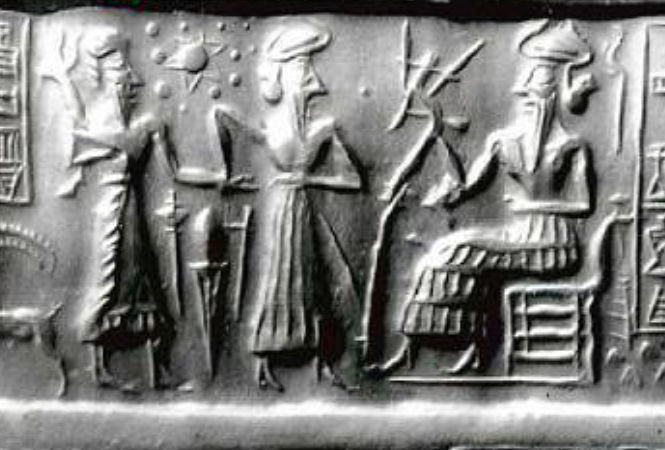
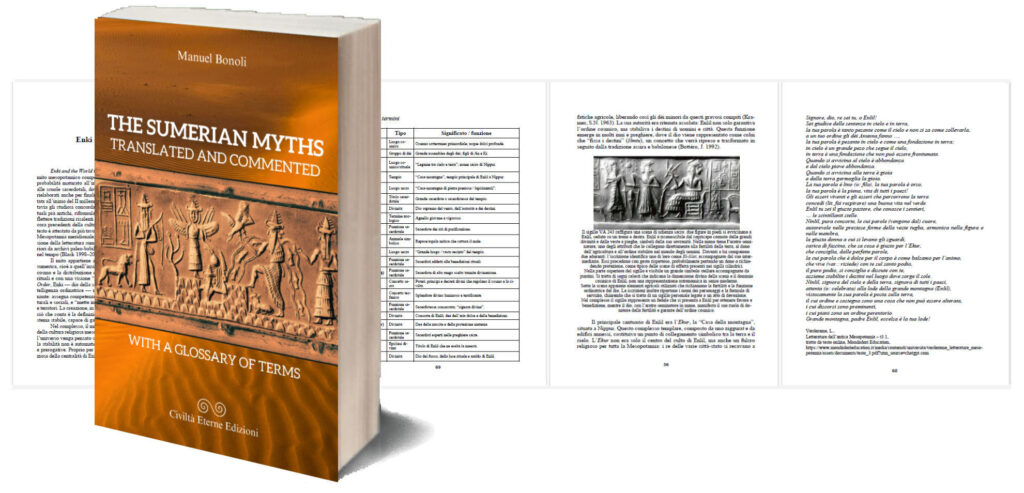
This text is taken from the book
“The sumerian mith translated and commented.
with a glossary of terms”
View the book index and description

The Sumerians occupied Mesopotamia between the end of the 4th and the beginning of the 3rd millennium BCE, integrating with the Semitic cultures of Uruk and Ubaid (Pettinato 1994). They achieved fundamental innovations in every field, gathering and reworking the immense cultural legacy left by the ethnic groups that had shaped the Neolithic Revolution in the Middle East (Liverani 2016).
The Sumerians explored the meaning of existence in depth, creating through their interpretation of the world a profound and complex mythology that was later absorbed and re-elaborated by subsequent Mesopotamian civilizations and beyond (Kramer 1961). Archaeological excavations carried out in Mesopotamia, on the mounds of debris that were once thriving urban settlements, have brought to light numerous texts written in cuneiform script—including economic treatises, administrative lists, hymns, incantations, invocations, and short poems (Bottéro 1989). From these recovered writings we have learned what the Sumerian theological principles were, as well as much of their intricate social and political organization (Pettinato 1994).
Despite the abundance of written sources, reconstructing a complete picture of Sumerian religious beliefs remains highly complex. The distinctive political structure of the city-states encouraged the development of differing doctrines which, throughout the Sumerian era, were never unified under a single overarching creed (Liverani 2016). Furthermore, it is important to recall the difficulties faced by Sumerologists in deciphering Sumerian writing and its evolution, and that this script cannot document from the very beginning the development of the cultural identity of this civilization, as it only reached a sophisticated expressive level during the 3rd millennium BCE (Kramer 1961).
The Sumerians were deeply attuned to the major religious questions of every age: who are the gods, how was the universe born, why was humankind created, and what is its destiny on earth and in the afterlife? Their answers to these fundamental questions are not, it is true, always clear, nor can we say that they found satisfactory responses to every problem. Yet we must acknowledge that the Sumerians addressed these themes with truly remarkable rationality and logic.
The Sumerian pantheon includes an extraordinarily large number of deities, though not all were worshipped equally or everywhere. Nevertheless, there existed a group of higher gods venerated as a unified whole. An, Enlil, and Enki are the principal deities of the Sumerian pantheon; together with Ninhursanga, Mother Earth, with Inanna, goddess of vegetation, love, and war, with Utu, the Sun god, and Suen, the Moon god, they govern the fate of the universe, determine human destiny, and hold the me (superhuman powers). These are the seven great gods frequently mentioned together in religious literature, forming the core of the celestial assembly presided over by Enlil.
Around these great gods stands a retinue of lesser deities, listed in the divine lists according to a strict hierarchical order. In reflecting upon the organization of the heavenly world, the Sumerians merely projected their own state system, founded on monarchical principles.

The structure of the pantheon mirrors Sumerian social organization, resulting in a depiction of the divine assembly comparable to that of human society—namely, one based on monarchy (Liverani 2016). The assembly of the Anunna (a term identifying “the children of An,” or divine offspring) generally consists of seven superior deities responsible for determining the destinies of gods and humankind (Pettinato 1994). An is the god of the celestial vault and the theoretical head of the Sumerian pantheon; nonetheless, actual supremacy falls to Enlil, who exercises sovereignty over the Earth and effectively controls the beings living upon it. Enki, instead, is the benevolent deity dwelling in the Apsu, the subterranean abyss that contains the fresh waters sustaining life (Kramer 1961).

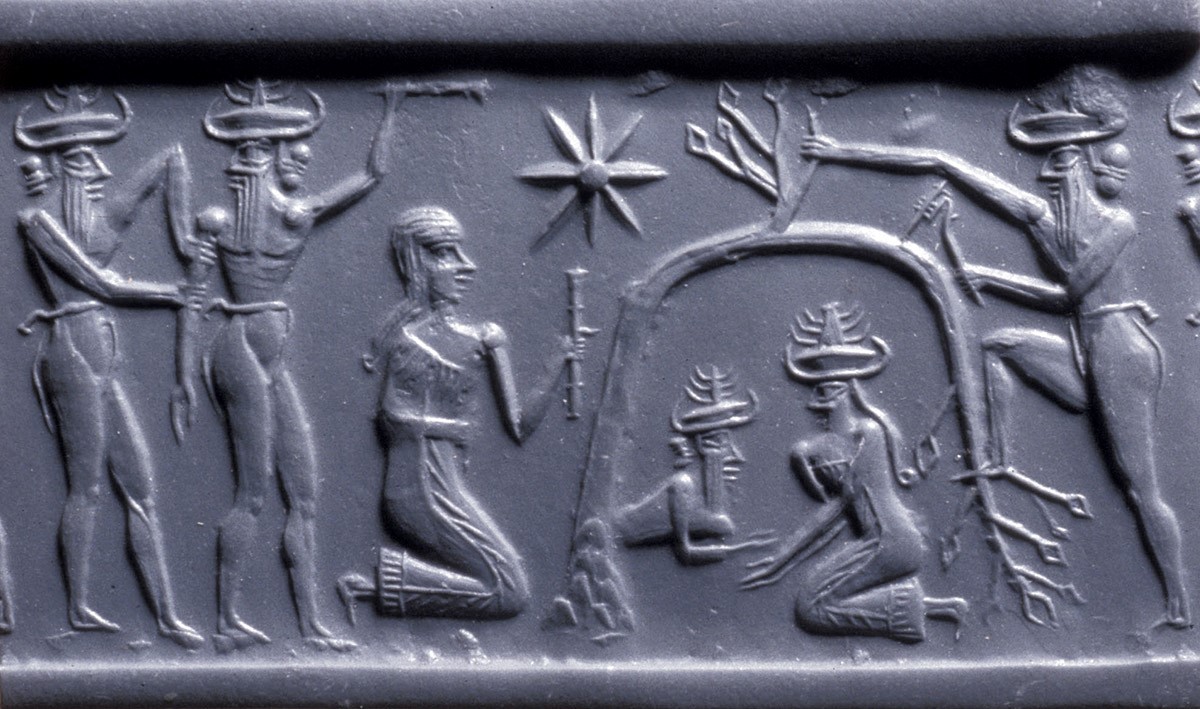
Among the most important deities is also Ninhursag, mother of all created beings, as well as the astral gods Utu, Suen, and Inanna, associated respectively with the Sun, the Moon, and Venus (Bottéro 1989). The Sumerians conceived their gods by reflecting on the manifestations of nature; even so, they imagined them in anthropomorphic form from the protostoric period onward, endowed with emotional traits and behaviors characteristic of human experience (Liverani 2016).
The Sumerians felt the need to assign meaning to existence; therefore, they developed countless explanations to account for why things are as they are, for the manifestations of nature, and for events linked to human affairs (Pettinato 1994). Thus, they imagined the existence of additional minor deities appointed to oversee every natural phenomenon and every activity carried out by human beings (Kramer 1961).
The religious beliefs of the ancient Sumerians were essentially divided into two major schools of thought: that of Nippur and that of Eridu (Pettinato 1994). Most religious texts assume the primordial existence of two primeval deities, An and Ki, associated respectively with the sky and the earth. Many cosmogonic myths begin by describing the separation of these two elements, accomplished by their son Enlil, who is associated with the air (Liverani 2016). The separation of heaven and earth is a recurring theme in the ancient world; indeed, in the 3rd millennium BCE—or perhaps earlier—it was absorbed and reinterpreted within the Egyptian doctrine of Heliopolis. One need only recall the separation of Geb (earth) and Nut (sky) achieved by their father Shu (air) (Bottéro 1989).
Regarding the origin of the primordial deities, significant differences of opinion existed. The doctrine of Nippur maintained that an embryonic world existed, containing within itself all the elements necessary for life, though in latent form. From this embryonic world emerged An (sky) and Ki (earth), in an entwined shape that the Sumerians imagined resembling a mountain (An-ki). From the union of An and Ki was born Enlil (air), the one who effectively separated heaven and earth, establishing the conditions required for life to exist. An “pulled” the sky upward, while Enlil “pulled” the earth downward. From the incestuous union of Enlil and Ki came all living beings: the offspring of the gods, humans, and every living creature on the planet (Kramer 1961). The supremacy of Enlil is never questioned, and it can be stated without hesitation that he was the most important deity in the Sumerian world (Pettinato 1994).
After the separation of earth and heaven, Enlil created the astral deities of the firmament: the god Nanna (associated with the Moon, known as Suen during the Akkadian period), Utu (the Sun), and Inanna (Venus). Enki, however, was born later from the union of An and Nammu, the goddess of creation associated with the abyss of subterranean fresh waters. The origin of Nammu is poorly attested, and she likely played a more significant role during the protostoric period (Liverani 2016). The doctrine of Eridu, by contrast, envisioned a dual creative principle: the fresh waters of the Apsu and the salt waters of the sea. From their union arose the sky, the earth, and the swirling waters, from which Enlil and Enki were later generated (Bottéro 1989).
According to Sumerian beliefs, there was a time when a portion of the gods was forced to labor upon the Earth to ensure the sustenance of their divine progenitors; therefore, the divine assembly decided to create humankind—a substitute capable of relieving the lesser gods from their heavy burdens (Kramer 1961).
On how the creation of humankind actually took place and which deities participated in it, significant differences of opinion exist. The Nippur tradition attributes humanity’s creation to Enlil. The Hymn to the Hoe contains one of the most meaningful versions: Enlil dug a hole in the ground and enabled humans to grow from it like sprouts; subsequently, he bestowed upon them the vital spirit, distinguishing them from all other creatures on Earth (Kramer 1961). The conception of humanity attributed to the Eridu tradition, however, credits the act of creation to the wisdom of Enki. According to the myth of Enki and Ninmah, the god of the Apsu fashioned the human matrix, after which the mother Nammu completed creation using clay (Bottéro 1989).
From the Hymn to the Hoe we learn a foundational concept of all Mesopotamian culture: “humankind expresses its divine nature and fulfills its destiny through work.” It is certainly no coincidence that the earliest cities in history emerged in the 4th millennium BCE among a people who understood their divine origin as manifest through labor.
Among the many archaeological finds that illustrate this religious conviction, one may recall the Ur-Nanshe relief displayed at the Louvre Museum in Paris (3rd millennium BCE). Perforated stone slabs served as votive objects, decorated in relief with carved inscriptions and figurative narratives. The inscription on the slab in question bears the name of Ur-Nanshe, the first ruler of the ancient Sumerian city-state of Lagash. It reads:“Ur-Nanshe, king of Lagash, son of Gunidu, built the temple of Ningirsu, built the temple of Nanshe; he built Apsubanda.”

The upper register shows Ur-Nanshe, depicted at twice the size of the other figures, contributing to the construction of a new sanctuary by carrying a basket of bricks upon his head. The king is accompanied by his wife, children, and high officials, each identified by their name engraved on their garments. In the lower register, the king of Lagash appears once again, surrounded by his court as he presides over the ritual banquet commemorating the building of the temple (Liverani 2016). This slab emphasizes the belief that labor brings human beings closer to the divine, for through it they may please the gods and fulfill the purpose for which they were created (Kramer 1961).
Archaeology has documented the deep attachment of the Sumerians to their principal deities, and the fact that every city possessed its own tutelary god (Bottéro 1989). The Sumerians believed that “kingship” was a gift sent down from heaven by the gods to lift humanity from the wretched condition in which it had lived before the civilizing process began; therefore, Sumerian rulers never failed to emphasize through their deeds that the fate of a kingdom—whether political or military—depended upon the benevolence of the city’s protective deity and upon the authority of Enlil, the undisputed head of the Sumerian pantheon (Pettinato 1994). Excavations of temples dedicated to the gods have revealed great religious devotion among the Sumerians, bringing to light many depictions of worshippers in prayerful attitudes.
For this people, the relationship with the gods was not merely an act of faith but a civic and cosmic duty. The deities were perceived as supreme sovereigns who governed the order of the universe, and human beings existed to serve them, maintaining the fragile balance between heaven and earth. Every Sumerian city possessed a principal temple dedicated to its tutelary deity, where priests and worshippers performed daily rituals to secure divine favor, agricultural fertility, and communal prosperity.
Within this context of intense devotion lies the discovery at Tell Asmar, an important archaeological site in the Diyala valley of Iraq, corresponding to the ancient city-state of Eshnunna. Here, in 1933–1934, during excavations led by Henri Frankfort, a remarkable group of twelve votive statues known as the “Tell Asmar Worshipper Statues” was unearthed (Frankfort 1939). They had been intentionally buried beneath the floor of the temple of the god Abu—a deity linked to vegetation and renewal—perhaps at the end of a phase of sanctuary renovation or during a ritual ceremony.
Dating between 2900 and 2500 BCE, the statues depict men and women in prayerful posture, their hands clasped and their gaze lifted upward. They were carved from various materials—gypsum, limestone, and alabaster—and range in height from 21 to 72 centimeters. Their function was votive: they were offered to the god as permanent representations of the worshipper, so that the act of prayer would continue even in their absence. In this way, devotion never ceased; the figure of the worshipper remained forever within the temple, embodying the spiritual presence of the dedicator and ensuring the continuity of the cult.
The most striking and distinctive feature of these sculptures is their enormous, wide-open eyes, inlaid with shell and dark stone, which convey a sense of mystical tension and vigilance. This fixed, penetrating gaze symbolizes constant attentiveness to the divine, an awareness of the gods’ presence, and the need to maintain uninterrupted contact with them (Bonoli 2017). The closed mouths and motionless faces, by contrast, express the stillness of silent prayer—the waiting for divine favor. The stylized yet solemn bodies reveal a conception of representation that is not naturalistic, but sacred: what matters is not resemblance to the worshipper, but the symbolic function of mediating between human and divine (Frankfort 1939).

The inscriptions present on some of the statues, bearing the names of the dedicators or brief offering formulas, show that they were personal gifts commissioned by individuals from various social backgrounds. However, their uniform style and the arrangement in which they were found within the archaeological deposit suggest that they once belonged to a coordinated ritual ensemble, likely placed originally in the temple cella, facing the statue of the god (Bonoli 2017). When they were buried—probably as an act of consecration or “withdrawal” from active worship—the statues ceased to function as instruments of prayer and became sacred objects, interred to preserve the purity of the holy space (Frankfort 1939).
The Tell Asmar Worshipper Statues represent an extraordinary testament to Sumerian spirituality. They reflect a conception of religion as continuous service, as constant participation in the cosmic order established by the gods. Through their simple yet solemn forms, these figures speak to us of a world in which faith was not confined to personal introspection, but was a public, communal act that bound the entire city to its protective deity. Their expressive power, preserved for over four millennia, still conveys today the image of a humanity seeking in the silence of stone an eternal connection with the divine.
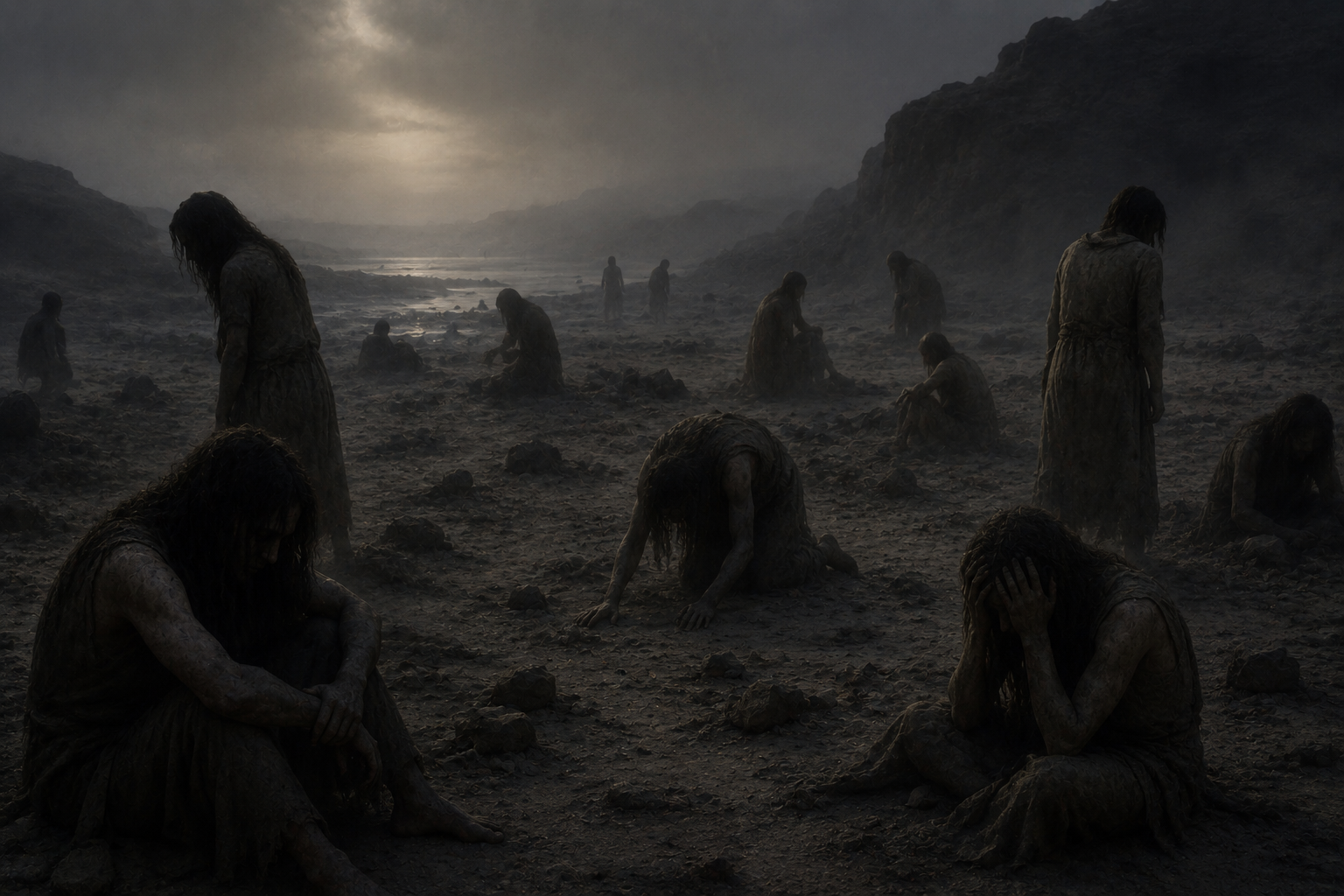
The Sumerian conception of the afterlife stands as one of the bleakest and most starkly realistic among the religions of the ancient Near East. In Mesopotamian tradition, death does not lead to a realm of blessedness nor to spiritual reward, but marks entry into the subterranean domain: the Kur, ruled by the goddess Ereshkigal, where existence persists in a diminished state, devoid of vitality and beyond redemption. As Pettinato observes, for the Sumerians “the afterlife is not a blessed place,” but a hopeless horizon from which no one can return to the light (Pettinato 1993).
Mythological sources confirm and elaborate this vision. In the myth of Inanna’s descent to the Netherworld, even the great goddess of love and kingship must submit to the laws of the realm of the dead, progressively losing her attributes and power during her descent and remaining imprisoned until aided by other deities. This narrative emphasizes the unyielding and autonomous nature of the underworld—a domain that not even the gods can freely manipulate (Jacobsen 1976; Bottéro 1987). Similarly, in the poem Gilgamesh, Enkidu and the Netherworld, the destiny shared by all mortals emerges: a condition of immobility, isolation, and ontological impoverishment. Souls (gidim) are described as shadows, powerless, compelled to feed on dust and stagnant water, unable to interact with the gods or influence the world of the living (Kramer 1961). The realm of the dead is sometimes portrayed as an inverted city—an organized structure devoid of social relations, activity, or light, where time does not flow and personal identity gradually fades (Verderame 2014).
Within this religious horizon, death appears as a universal and inescapable fate, independent of the moral behavior or social standing of the deceased. There is no divine judgment that rewards or punishes, nor any distinction between an afterlife for the righteous and one for the wicked. As Jacobsen notes, the Sumerians conceived death as a neutral yet absolute reality, shared by all and erasing the distinctions of earthly life (Jacobsen 1976). It is telling that even the king—depicted in life as a sacralized figure connected to the gods—is reduced in the afterlife to the same condition as all other mortals.
Geographical and historical conditions seem to have reinforced this perception. Mesopotamia was a fertile but unpredictable land: sudden floods, droughts, invasions, and political instability fostered a sense of precariousness and existential fragility (Bottéro 1987). This historical experience nourished a religion rooted in the awareness of transience and the absence of post-mortem redemption. For this reason, the only conceivable form of “immortality” for a Sumerian was not post-mortem, but in the memory left among the living. Epic literature—especially the Epic of Gilgamesh—emphasizes the idea that humankind cannot escape death, but can aspire to endure through lasting achievements, monuments, and the fame that survives over time (George 1999). Hence the recurring theme in Sumerian texts of “attaining a lasting and enduring name,” as noted by Pettinato (1993): building cities, temples, walls, inscriptions, and political accomplishments meant inscribing oneself into collective memory.
Funerary practices reflect this paradigm with coherence. Unlike in Egypt, where the tomb served as a device for the regeneration and salvation of the soul, Mesopotamian funerary offerings primarily aimed to provide minimal sustenance to the dead, easing their suffering but without promising a new existence (Hallo & Simpson 1998). These were not rites of transformation, but attempts to maintain ritual contact with the shades, ensuring they would not trouble the world of the living.
Overall, the Sumerian view of the afterlife functions as a structural element of the cosmic order: a separate, autonomous, universal realm with no possibility of redemption. It expresses a religiosity in which earthly life constitutes the only sphere of action and fulfillment of one’s destiny, and where true survival resides solely in collective memory—in monuments, texts, and deeds that withstand the passage of time.
Bibliography
Bottéro, Jean. Religion in Ancient Mesopotamia. 1989.
Frankfort, Henri. The Art and Architecture of the Ancient Orient. 1939.
George, Andrew. The Epic of Gilgamesh: A New Translation. 1999.
Hallo, William W., and William K. Simpson. The Ancient Near East: A History. 1998.
Jacobsen, Thorkild. The Treasures of Darkness: A History of Mesopotamian Religion. 1976.
Kramer, Samuel Noah. History Begins at Sumer. 1961.
Liverani, Mario. The Ancient Near East: History, Society and Economy. 2016.
Pettinato, Giovanni. The Sumerians. 1994.
Verderame, Lorenzo. Studies in Mesopotamian Religion and the Afterlife. 2014.

Comments (0)